


Why Booking Business Class with Qantas Points Is Harder Than It Looks
Booking Business Class with Qantas Points isn’t just about having enough points. Availability is limited, competition is intense, and booking has become an iterative process. Here’s how Qantas Business Class rewards really work — and why preparation and flexibility now matter more than ever.
In Part One, we pulled apart the influencer version of “cheap” Business Class flights and showed why the maths often doesn’t hold up once you zoom out.
This is Part Two — where theory meets reality.
Because even if you accept that Business Class can represent strong value on paper, there’s a bigger question most content never answers:
How do you actually book these flights with Qantas Points, consistently and without losing your sanity?
The short answer: it’s harder than most people expect.
The longer answer: it’s absolutely doable — if you understand how availability really works in 2026 and beyond.
Let’s break it down.
First Principles: What You’re Actually Booking
When people say “I booked Business Class with points,” they’re usually referring to one of two things:
Qantas Classic Reward seats, or
Partner airline reward seats booked through Qantas
Both are capacity controlled.
Both are limited.
And both exist independently of how many empty seats are still for sale on the plane.
This is the first mental shift that matters:
You are not buying a seat. You are competing for inventory.
A More Competitive Landscape Than Ever Before
What’s often missed in points discussions is who you’re competing against.
There are now more people holding large points balances than at any point in the program’s history. Credit card bonuses have grown, business spending has shifted onto points-earning cards, and frequent flyer programs have become more mainstream.
The result is a market where:
Six-figure balances are common
Seven-figure balances aren’t unusual
Many travellers are actively monitoring availability year-round
In other words, you’re not competing with casual flyers who “might” book if something pops up.
You’re competing with:
Highly engaged frequent flyers
Status holders with priority access
Travellers using alerts and search tools
People who already have the points ready to deploy
That’s why availability disappears quickly — and why planning, flexibility, and surplus points matter more now than they did five or ten years ago.
The rules haven’t changed.
The competition has.
Want to get ahead of the competition without having to reinvent the wheel? Download your Free Qantas Starter Kit here.
The Impact of Classic Plus Flight Rewards on Availability
Another factor quietly reshaping the landscape is Qantas’ introduction of Classic Plus Flight Rewards.
On paper, Classic Plus sounds like a win:
More seats made available
No fixed reward inventory limits
Pricing that flexes with demand
In practice, it’s changed the ecosystem in an important way.
Classic Plus seats are effectively revenue seats made bookable with points, often at very high points prices. That gives Qantas a strong incentive to:
Divert inventory away from fixed-price Classic Reward seats
Monetise demand using dynamic points pricing instead
The result is a two-tier system:
Classic Reward seats: limited, fixed pricing, highly competitive
Classic Plus seats: widely available, but often poor value
On popular long-haul routes, this has meant:
Fewer Classic Reward seats released
Faster sell-outs when they do appear
A growing gap between “available” and “good value”
This is why many travellers now see flights that are technically bookable with points — but at costs that make little sense compared to cash fares or alternative redemptions.
Classic Plus increases access.
It doesn’t increase value.
And it makes understanding the difference — and acting quickly when true Classic Reward seats appear — more important than ever.
The Core Challenges of Qantas Business Class Redemptions
1. Availability Is Limited by Design
Qantas does not release unlimited Business Class reward seats.
On popular long-haul routes, you’ll often see:
Zero seats
One seat
Two or more seats (occasionally)
That’s per flight — not per day.
Once they’re gone, they’re gone.
This is why people with six-figure points balances still struggle to “find anything.”
2. Release Timing Is Both Predictable and Random
This is where a lot of outdated advice falls apart.
Historically, Qantas (and many partner airlines) released reward seats:
No earlier than ~353–355 days before departure
That upper boundary still exists.
What’s changed is everything after that.
In recent years, airlines have increasingly:
Released seats in randomised batches
Tied releases to internal yield reviews
Dropped availability alongside promotions or fare activity
Released seats, pulled them, then re-released later
The result?
It’s no longer “set an alarm at 355 days and press go.”
More often, it’s:
Multiple searches
Incremental improvements
Booking a good-enough option early
Then refining as better availability appears
Modern points booking is iterative, not transactional.
3. Popular Routes Are Brutal
Routes like:
Sydney–London
Melbourne–Los Angeles
Sydney–Tokyo
are hammered by:
High-status frequent flyers
Families booking multiple seats
Corporate travellers with large balances
Automated alerts and search tools
If you’re searching:
One route
One date
One city pair
then you’re competing at maximum difficulty.
Flexibility here isn’t a “nice to have.”
It’s the difference between success and frustration.
4. Taxes and Surcharges Can Be Eye-Watering
Even on a “points flight,” you still pay:
Airport taxes
Government charges
Airline-imposed surcharges
On Qantas-operated flights, these are often manageable but noticeable.
On some partner airlines — particularly highly-coveted ones like Emirates — they can be extreme.
Depending on:
Routing
Departure airport
Cabin class
it’s not uncommon to see four-figure cash co-payments per person, each way.
This is a crucial detail that’s often glossed over in social media content. A Business Class redemption that looks incredible on points can quietly require thousands of dollars in cash just to ticket.
That doesn’t automatically make it bad value — but it dramatically changes the equation.
How People Actually Succeed
1. They Use Tools — but Understand Their Limits
Manual searching works, but it’s slow.
This is where tools like Gyoza Flights help.
They:
Surface availability faster
Scan routes you may not think to check
Reduce the time cost of searching
What they don’t do is create seats.
Think of them like radar, not magic.
You still need:
Flexibility
Timing
And crucially, points ready to deploy
2. They Treat Booking as a Process, Not a Moment
This is where experience shows.
Rather than waiting for the “perfect” flight, many successful bookings follow a pattern:
Lock in something early
Accept that it may not be ideal
Monitor for improvements
Upgrade the itinerary when better seats appear
Which brings us to the real bottleneck - not availability or tools, but having enough points to act with flexibility when opportunities appear.
3. They Optimise for Outcomes, Not Perfection
One of the biggest mistakes people make when booking Business Class with Qantas Points is aiming for the perfect itinerary from day one.
Perfect usually means:
Non-stop
Ideal departure time
Preferred airline
Exact dates
In a competitive environment, that mindset often leads to paralysis — or missed opportunities.
Instead, successful bookings tend to prioritise:
Getting into the cabin
Locking in dates
Protecting downside
That might mean:
Accepting an extra stop initially
Departing from or arriving into a nearby city
Booking an “imperfect” routing as insurance
Once you’re holding a confirmed Business Class seat, your leverage improves dramatically. You’re no longer chasing availability — you’re refining it.
This mindset shift matters because Qantas availability isn’t static. Routes improve, aircraft swap, inventory is rebalanced, and better options can appear months after your initial booking.
People who succeed don’t wait for perfection.
They secure progress, then upgrade the outcome when conditions allow.
That approach only works, however, if you understand the system — and have the points flexibility to adapt when opportunities emerge.
Case Study: Why Surplus Points Create Optionality
Here’s a real-world example that illustrates how modern points booking actually plays out.
For a recent Europe trip, flights were booked roughly 11 months out. At the time, the only viable option was a two-stop Business Class itinerary.
Not ideal — but it served as a backstop:
Dates locked in
Seats secured
Travel protected
Months later, something changed.
A far better routing was released — fewer stops, better schedule. To secure it, the new itinerary had to be booked immediately, using additional points, before the original booking could be cancelled and the points refunded. I could have cancelled my initial trip first to free up the points, but doing so would run the risk of having no flight at all, closer to the travel date, with less alternatives. That idea didn’t fit my risk profile.
That then meant:
Holding enough points to temporarily cover both bookings
Understanding refund rules and timelines
Being comfortable adapting as availability evolved
Once the new flights were confirmed, the original booking was released and the points refunded.
The takeaway is simple:
Flexibility in booking requires flexibility in points balance.
If your points balance only just covers one itinerary, you’re forced into “take it or leave it” decisions. If you maintain a buffer through consistent earning, you can adapt as better opportunities emerge.
Why Systems Beat One-Off Wins
This is where most influencer advice misses the mark.
They focus on:
One screenshot
One redemption
One moment in time
That’s fine if your whole job is to travel and post it online, but for most people seeking to earn points for individual, couple or family travel, they don’t have that kind of freedom of routing or timing.
Fore the rest of us, Business Class points travel is a repeatable problem, not a viral highlight.
The people who succeed long-term:
Earn points continuously
Understand their annual earning capacity
Maintain buffers instead of draining balances
Can act quickly when availability appears
That doesn’t come from hacks.
It comes from having a system.
The Bottom Line
Booking Business Class travel with your Qantas Points is:
Harder than social media suggests
More dynamic than it used to be
Deeply biased toward preparation
Tools like Gyoza Flights reduce friction.
Flexibility improves outcomes.
Understanding surcharges avoids nasty surprises.
But none of it works if your points balance only exists in theory.
In Part Three, we’ll zoom out again — and look at how to design a points-earning system that supports real-world booking behaviour, not just calculator value.
Because availability doesn’t reward hope.
It rewards readiness.
If you want to understand how to build a points balance that supports this kind of flexibility — and how to spot availability when it appears — Part Three will explore that in detail. You can join the mailing list below to be notified when it goes live.
Related posts




A Year in Review: Why My Qantas Points Strategy Shifted This Membership Year
This isn’t a points total recap. It’s a look at how my Qantas Points strategy shifted this membership year — away from promo-driven spending and toward a calmer, more repeatable system built around everyday spend.
Most “year in review” posts focus on totals.
Big numbers. Screenshots. Highlights.
This one doesn’t.
Qantas measures behaviour by membership year, not calendar year — and with one month still to go, this isn’t about final outcomes. Instead, it’s about something more useful: how my strategy shifted, and why.
The biggest change this membership year wasn’t earning more points.
It was getting clearer on what should count as everyday spend — and building a system that reflects real life, not just promotions.
When points stop reflecting life, the system breaks
One of the easiest traps in points collecting is letting the earning mechanism dictate spending.
That’s when:
You buy things earlier than you need.
You buy more than you otherwise would.
Points stop being a by-product of life and start driving behaviour.
Over time, that creates friction. It also makes the system fragile — because it only works if you keep forcing decisions.
This membership year, I deliberately stepped back from that.
Why I reduced reliance on Qantas Wine
Wine has historically been a strong points earner for me — and it still can be.
But it’s not a significant part of my everyday lifestyle.
That meant any meaningful volume of wine-related points was coming from:
buying ahead of need;
buying more than I’d otherwise consume (and doing a lot of cellaring); and
spending because of points, not because of life.
This year, I reduced that reliance.
Not because wine offers are bad — they’re often excellent — but because earning points should reflect what you already spend, not what you can be encouraged to buy.
Stepping back from wine made the system:
less capital-intensive;
less promo-dependent; and
more honest.
And, importantly, more sustainable.
Dialling up gift cards — deliberately and precisely
At the same time, I deliberately dialled up gift card usage.
Not as a shortcut.
Not to inflate numbers.
But as a precision tool.
Gift cards weren’t about spending more — they were about extracting more value from spend that was already happening.
Used properly, they:
route everyday purchases through higher-earning channels;
allow stacking without changing behaviour; and
turn neutral spend into strategic spend.
This wasn’t blanket buying or speculative stockpiling. It was:
specific retailers;
clear use cases; and
purchased when the numbers made sense.
That distinction matters. Gift cards are powerful because they amplify existing spend — not because they create new spend.
Insurance: timing matters, but it’s not repeatable
Insurance played a role this year, but it’s worth being clear about how.
The points earned here came from timing a policy review to coincide with a promotion. That’s not something you repeat every year, and it’s not something you should force.
Insurance decisions should always be driven by:
coverage;
cost; and
suitability.
Points are secondary.
That said, if you’re already reviewing a policy, aligning timing with a strong Qantas offer can deliver outsized value. It’s not a core system — it’s a lever you pull when the timing is right.
What didn’t change: cards, structure, restraint
One of the quieter shifts this year was actually not changing much.
My card setup remained largely the same. My Qantas Titanium credit card is the workhorse of the points-earning system and changing it for another card wouldn’t make sense at this point.
There was no constant churn.
No weekly adjustments and time-consuming planning.
Once a structure is right, the goal isn’t activity — it’s consistency.
Letting systems run without interference is often the most underrated skill in points earning.
How the earning mix changed
Looking at where points come from — not just how many — tells a much clearer story about strategy.
It highlights whether points are being earned from everyday behaviour, or from discretionary spending driven by promotions.
2024 Membership Year
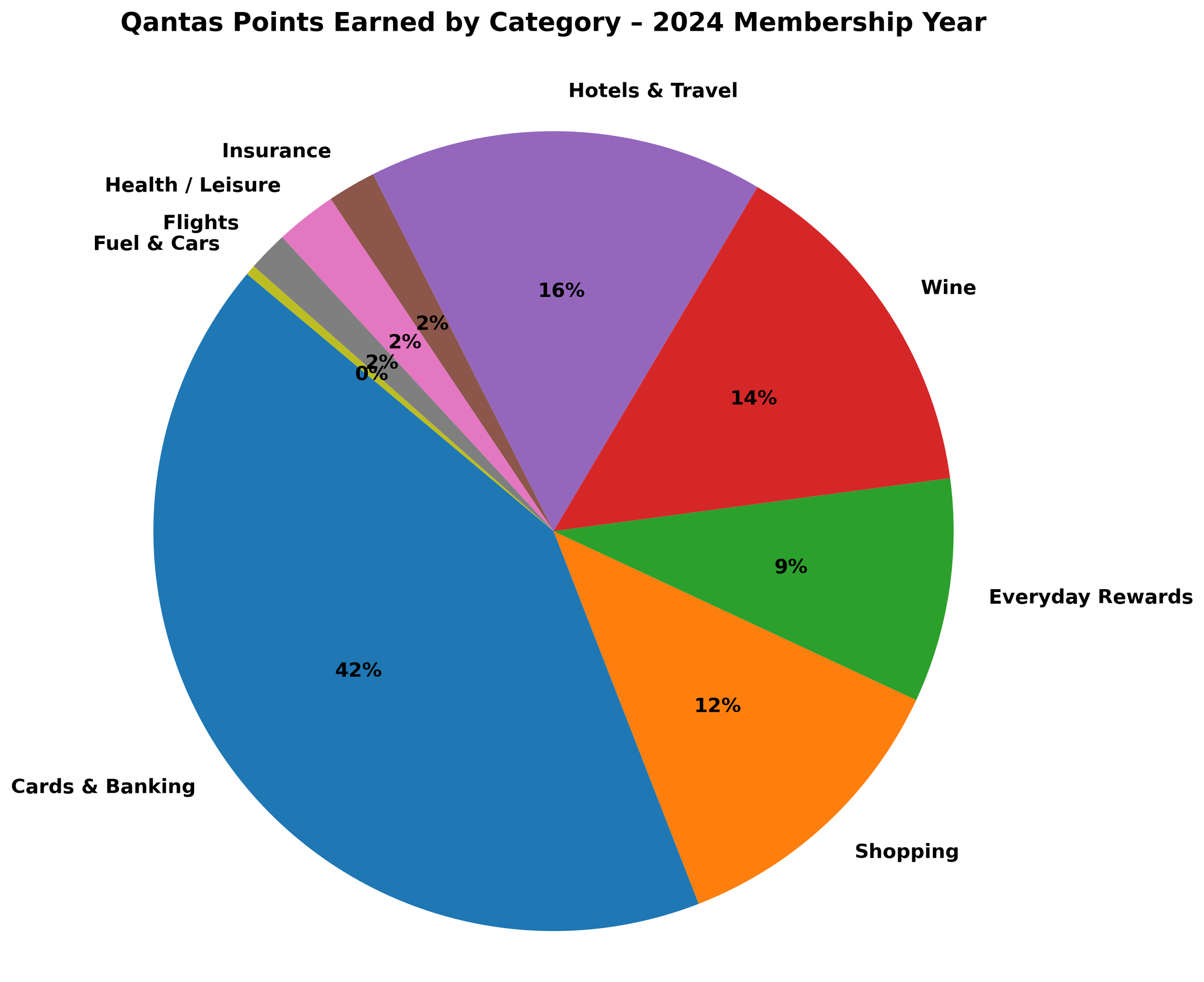
A meaningful share of points came from categories that were not part of my everyday lifestyle, contributing to a more episodic and promo-driven earning profile.
2025 Membership Year
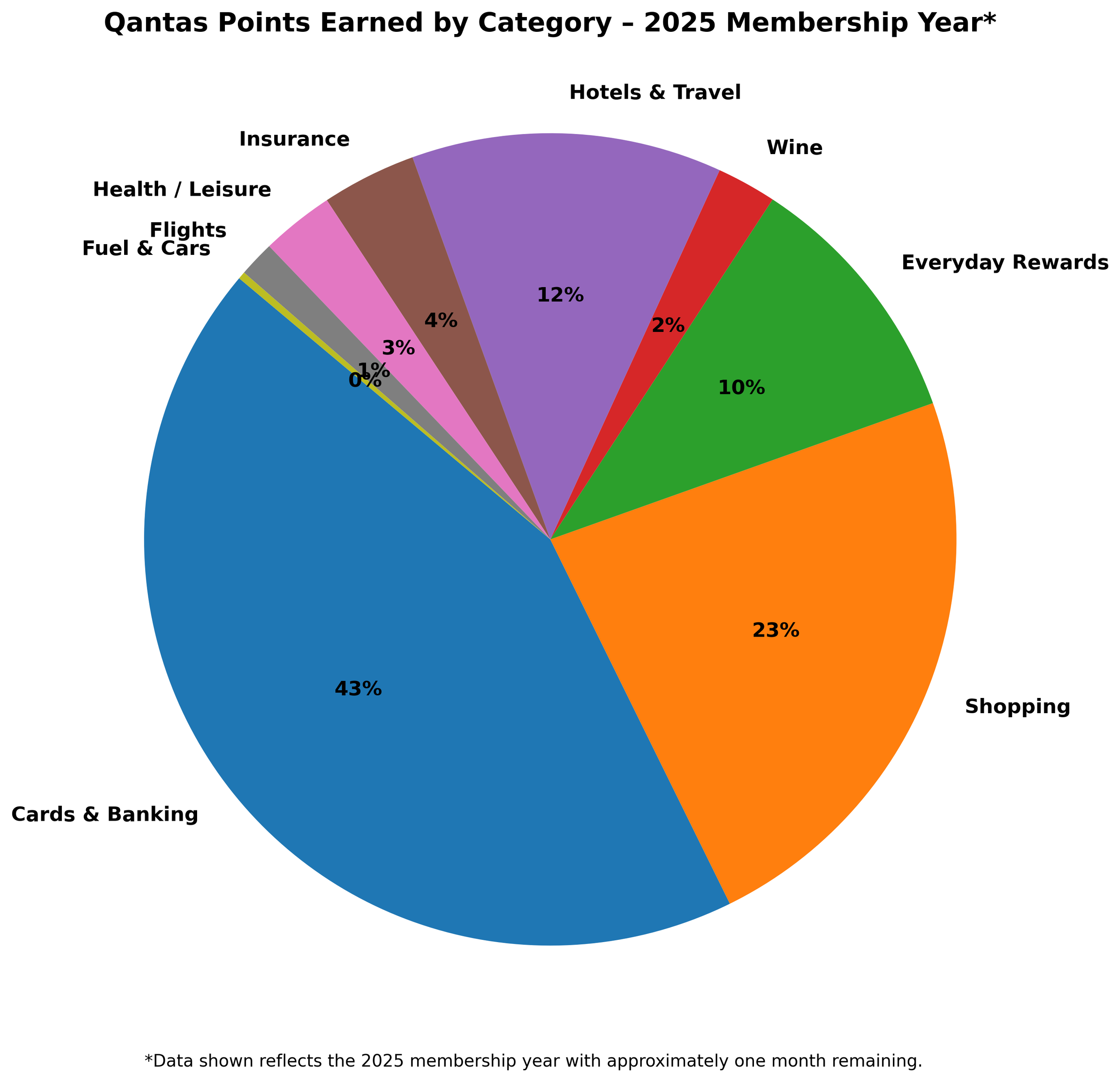
The profile shifted toward genuinely repeatable earning — Everyday Rewards and shopping-led spend — with reduced reliance on non-everyday categories.
Reducing pressure on a single account
Another important shift this year was adding Qantas Business Rewards as a parallel earn stream.
This didn’t inflate my personal Qantas Frequent Flyer results — but it did reduce the pressure to force outcomes into one account.
Separating business-linked earning from personal lifestyle earning made the system calmer and more accurate. Each account now reflects what it’s meant to reflect.
The real outcome: fewer decisions, less noise
The biggest change this membership year wasn’t numerical.
It was psychological.
fewer “should I?” moments;
less urgency around every promotion; and
more confidence letting good offers pass.
The system became quieter — and that’s usually a sign it’s working.
What comes next
At the end of my membership year, I’ll publish a clean, side-by-side comparison — measured the way Qantas actually tracks behaviour.
Not to prove anything.
But to show what happens when points strategies align with real life instead of competing with it.
For now, this review isn’t about totals.
It’s about building a system you don’t have to fight.




Your Points Balance Isn’t the Goal — The Moments You Create With It Are
A high Qantas Points balance looks impressive, but it’s not the goal. The real reward is the moments points create — not the number in your app. Here’s why.
The High of Watching Your Balance Rise
There’s a reason Instagram is full of screenshots showing off 250,000… 400,000… 1,000,000 points.
It looks like an achievement.
It feels like progress.
It gives you the dopamine hit of “I’m getting somewhere” or “I’m winning”.
And I get it — I used to chase that feeling too.
I’d refresh the Qantas app after a big Marketplace haul or a wine bonus kicking in, just to see that counter jump. For a moment, you feel clever. You feel like your system is paying off.
But the truth is this:
The high is temporary.
A day later — sometimes an hour later — you’re already looking for the next offer, the next bonus, the next jump in points.
In that cycle, something gets lost:
The actual reason you started earning points.
The Moment That Actually Matters
The most valuable points moments I’ve had in 10+ years of earning points have nothing to do with the number in my app.
They happened when I was:
sitting in business class on a long-haul flight next to someone I love
booking a trip I never would’ve paid cash for
surprising someone with an upgrade
turning a standard holiday into something unforgettable
flying somewhere incredible for almost nothing out of pocket
In those moments, my points balance never crossed my mind.
Because the joy doesn’t come from having points — it comes from using them.
It comes from the experience points unlock, not the balance itself.
Why a Points Balance Can Become a Distraction
1. You Start Thinking Like a Collector, Not a Traveller
Instead of planning meaningful redemptions, you start planning ways to make the number bigger.
You chase promotions that don’t align with your goals.
You focus on accumulation instead of value.
The balance becomes the mission, not the travel.
2. You Become More Comfortable Wasting Points
This is the part nearly every points-earner learns the hard way — I certainly did.
A large balance tempts you to say things like:
“It’s fine, I’ve got heaps.”
“I’ll just use points for this item.”
“That flight isn’t great value, but whatever — I can afford it.”
The more points you have, the easier it becomes to throw them around.
But when you’re closer to your goal — when you have just enough for a dream redemption — your behaviour changes:
you’re more deliberate
you protect your points
you focus on high-value outcomes
you avoid unnecessary spending
Ironically, having fewer points often makes you a smarter points user than having many.
3. You Miss Out on the High-Value Redemptions
The redemptions worth thousands of dollars — the big wins — come from intentional planning, not hoarding.
But when your balance is huge, you’re less motivated to:
track availability
look for sweet spots
time your redemptions
align points with real travel goals
A large balance can create complacency, and complacency is expensive.
4. You Lose Connection to Your ‘Why’
You started earning points to travel better.
To unlock experiences.
To create moments with meaning.
Not to watch a number climb endlessly for its own sake.
So let’s call it what it is:
More points. More casual spending. More drift.
Less purpose, less planning, less joy.
When the pursuit becomes the number, everything else fades.
Systems > Hoarding
The most effective points strategies aren’t built on hacks or Instagram-worthy balances.
They’re built on:
predictable earning
smart use of Qantas partners and their offers
stacking where it makes sense
intentional, goal-aligned redemptions
A system gives you clarity and direction.
A balance alone gives you noise.
A system gets you onto flights.
A balance just sits there.
So Here’s Your Reminder
If you’re deep in the points world, it’s normal to think the goal is “more.”
More earning.
More offers.
More Qantas partners to switch your spending to.
But the real goal is the experience — the moment points unlock.
Because:
Your points balance isn’t the achievement.
The memories you create with it are.
Want a System That Actually Gets You Flying?
If you want a simple, structured approach that earns consistently and moves you closer to the moments that matter:
Download my free Qantas Points Starter Kit, or
Choose the Points Guide that matches your level, or
Book in a personalised consultation to build a unique system around your life.
Qantas Points. Made simple.