
When Earning Points Feels Slow, It’s Rarely Because You’re Doing It Wrong
If earning Qantas Points feels slower than it should, the problem is rarely effort. This article explains why progress stalls, how everyday earning and bonus offers actually work together, and how to fix the system behind your strategy.
If you’ve ever looked at your Qantas Points balance and thought, “I’m doing all the right things — why isn’t this moving faster?” you’re not alone.
That tension came through clearly in a recent Instagram poll. Some people wanted to know how to speed up everyday earning. Others wanted clarity on which bonus offers are actually worth pursuing.
At first glance, those look like two different questions.
They’re not.
They’re both expressions of the same frustration:
Progress doesn’t feel proportional to effort.
And when that happens, most people assume the problem is that they’re not doing enough.
It usually isn’t.
Why this article exists
This article sits at the centre of how The Points Pilot thinks about earning Qantas Points.
If you’ve ever felt like you’re following the advice, putting in the effort, and still not seeing the momentum you expected, this is where to start. Not with tactics — but with the system underneath them.
Effort isn’t the problem. The system is.
I touched on this idea on Instagram recently: when progress stalls, it’s rarely because you’re lazy, careless, or ‘bad at points’.
Most people who end up here are already doing more than the average member. They’ve linked programs, opened cards, jumped on promotions, read articles, watched videos, and tried to be intentional.
The issue isn’t effort.
The issue is that the system behind that effort isn’t working the way it should.
When a system is misaligned, adding more effort doesn’t speed things up. It just increases friction — more checking, more chasing, more second-guessing why the results don’t match the input.
That’s usually the moment people start blaming themselves, when in reality the structure just needs adjusting.
The three levers that actually move your points balance
Every sustainable points strategy is built on three levers that I introduced recently in another article:
Volume – how much spend flows through your setup
Coverage – how much of that spend earns points at all
Multipliers – bonuses, promotions, and accelerators
Every tactic you’ve ever seen — everyday earning tips, credit card bonuses, limited-time promos — works by pulling one or more of these levers.
Where most people get stuck isn’t that they’re using the wrong lever.
It’s that they’re over-relying on one, while the others quietly underperform.
That imbalance is where frustration starts.
Everyday earning: slow, boring, and foundational
(Volume + Coverage)
Everyday earning rarely feels like progress — which is exactly why it’s so easy to underestimate.
When it’s working properly:
Most of your regular spending earns points by default
You don’t need to think about optimisation every day
Your balance rises steadily, even in months with no big offers
There are no spikes here. No screenshots. No sudden wins.
But this is the engine. It sets the floor your entire strategy rests on.
When everyday earning is weak or patchy, progress becomes dependent on bursts of activity. That’s when people start overcompensating — usually by chasing promotions.
If earning feels slow at this level, it’s rarely because spend is too low.
It’s because too much spend isn’t earning at all, or isn’t flowing cleanly through the system.
This is where most early-stage strategies quietly leak points.
Bonus offers: powerful accelerators with a hidden cost
(Multipliers)
Bonus offers are appealing because they work.
A well-timed promotion can deliver a large number of points in one hit. Compared to everyday earning, it feels fast — almost like a shortcut.
But over time, a familiar cycle often develops:
A strong promo delivers a surge of points
Progress suddenly feels fast again
The promo ends
Earning drops back to baseline
Frustration sets in
The search for the next offer begins
This creates a rhythm of highs followed by flat earning, which can feel demoralising even when the total balance is technically growing.
The issue isn’t that bonus offers are bad.
It’s that they’re being asked to do a job they weren’t designed for.
There’s also the issue that it’s easy to end up spending money you don’t need when chasing promos, just to get that ‘next hit’ of a points spike. Trust me, I’ve been there.
Why chasing promos eventually feels exhausting
Bonus offers are multipliers, not engines.
When they sit on top of a solid everyday system, they accelerate progress smoothly. When they’re used instead of that system, they create volatility.
This usually shows up as:
Constant scanning for the next ‘good’ deal
Second-guessing whether an offer was worth it
Feeling behind when suitable promotions aren’t running
Progress that feels emotional rather than predictable
At that point, earning starts to feel reactive. Even stressful.
And that’s usually when people assume they need more effort — when what they actually need is better alignment.
A quick diagnostic: where systems usually break down
This isn’t a checklist to fix everything at once — just a way to orient yourself.
You may be over-relying on promotions if:
Your balance only moves meaningfully during big offers
Earning feels flat between promos
You feel pressure to act quickly whenever something appears
You may have a coverage issue if:
Large parts of your regular spending earn no points
You often realise after the fact that something could have earned points
Progress feels slower than expected despite reasonable spend
And you may have a system alignment issue if:
You’re putting in effort, but results feel inconsistent
You’re doing “the right things”, but momentum never sticks
Points earning feels more tiring than it should
None of these are failures.
They’re signals — and systems can be adjusted.
This was never an either/or question
The original question wasn’t really “Should I focus on everyday earning or bonuses?”
It was something more honest:
“Why doesn’t this feel like it’s working the way I expected?”
The answer isn’t more effort, more deals, or more complexity.
It’s alignment.
Everyday earning sets the floor
Bonus offers raise the ceiling
The three levers work best when they’re pulling in the same direction
When that happens, progress becomes calmer. More predictable. Less dependent on timing or hype.
How this fits into your journey with The Points Pilot
This article explains why earning can feel harder than it should.
The next step is understanding which lever you’re under-using, and which one you’ve been leaning on too heavily.
That’s exactly what the The Points Pilot guides are designed to do. They’re structured by level because different systems break in different ways — and strengthening the foundation first is what makes acceleration sustainable.
And if your setup is already complex — multiple cards, business spend, irregular income, or upcoming travel — a one-on-one strategy session can help rebalance the system quickly and remove unnecessary friction.
You don’t need more effort.
You need a system that does more of the work for you.
That’s where real momentum starts.
And if you don’t have that yet, today is the day to change that.
Check out related articles below:




Building a Points System That Makes Business Class Travel Repeatable
Business Class travel on points doesn’t become repeatable through luck or hacks. It becomes repeatable when you build a points system that works quietly, consistently, and over time.
If you’ve made it this far, you already know three things most people never fully internalise:
Business Class reward seats are not ‘always there’. They appear in windows, they disappear fast, and availability is tighter than most people expect.
Booking well is a skill. The people who succeed aren’t luckier — they’re prepared, flexible, and decisive when the moment arrives.
Even ‘free’ flights aren’t free. Booking Business Class seats with points requires a substantial commitment to point earning that goes beyond a few simple tricks or hacks.
But there’s a another truth that sits underneath all of those:
Regularly flying Business Class on points isn’t a booking problem. It’s a systems problem.
Most people fail before they even get to the booking stage — not because they don’t know where to look, but because their points balance never becomes strong or predictable enough to give them options.
This article is the ‘bring it all together’ piece. Not a list of hacks. Not a step-by-step setup guide. A system-level explanation of what actually makes Business Class possible every year (or every other year), and why “doing a few clever things” usually doesn’t compound into repeatable results.
If Part One was about the real cost of booking Business Class with points, and Part Two was about how to execute when it’s time, then Part Three is about this:
Building a points-earning system that keeps working when you’re not actively thinking about points — and creates the kind of balance that makes premium redemptions realistic, not aspirational.
1. The Shift Most People Never Make: From Tactics to Systems
A tactic is something you do.
A system is something you live inside.
Tactics are isolated: a sign-up bonus, a limited-time promo, a well-timed purchase, a good redemption one year. They can be powerful — but they’re also fragile. They rely on attention, timing, and the motivation to keep hunting.
Systems are coordinated. They’re designed so that your normal life produces points reliably, without requiring constant decision-making. The goal is not to “win” points occasionally — it’s to raise your baseline.
This matters because flying Business Class isn’t cheap in points terms. If you want repeatability, you can’t rely on occasional spikes. You need consistency, and consistency doesn’t come from being clever. It comes from having fewer moving parts, fewer leaks, and a structure that holds even when you’re busy.
Here’s the uncomfortable truth:
Most people don’t have a points strategy. They have a handful of tactics.
And tactics don’t compound unless they’re integrated.
The rest of this article is about what integration actually means in practice — and why it’s harder than it looks.
Want to build your own points system without having to start from scratch? Download your Free Qantas Starter Kit here.
2. The Three Levers That Determine Your Annual Points Outcome
When you zoom out, nearly every points strategy — good or bad — can be explained by three levers. Most people pull one lever hard and ignore the other two. That’s why their results stall.
Lever 1: Spend Volume (How much flows through your life)
This sounds obvious, but it’s more nuanced than “spend more.”
Your spend volume is the total amount of money that moves through your world each year — not just your discretionary purchases, but the full set of household decisions: groceries, fuel, utilities, insurance, travel, subscriptions, and (for some people) business expenses.
A common failure point is that people underestimate how much volume they actually have, because their spending is distributed across multiple accounts, multiple cards, multiple “categories,” and sometimes multiple people in the household.
And here’s the key: volume isn’t inherently good or bad.
It’s simply the raw material your points system can convert.
If your volume is low, you need a system that respects that reality and leans more heavily on high-impact decisions. If your volume is high, you need a system that captures that flow without creating admin fatigue.
Either way, the mistake is the same: treating volume as a moral issue (‘I shouldn’t spend’) instead of a design input (‘What already exists, and how do I structure it responsibly?’).
Lever 2: Coverage (How much of that spend actually earns)
Coverage is the silent killer.
It’s not the difference between earning 1 point per dollar and 2 points per dollar. It’s the difference between earning points on most of your spend — and earning points on only the spend you remember to think about.
Most people have significant ‘dead spend’: money leaving their bank account that never touches their points balance. Not because they’re doing anything wrong — but because they’ve never mapped their life in a way that makes the gaps visible.
Coverage problems often show up as:
fragmentation (too many places your spend can go);
inconsistency (a system that only works when you’re paying attention); and
blind spots (categories you never think about because they feel ‘fixed’ or unavoidable).
Coverage is also where points strategies become deceptively complex. Because improving coverage usually requires structural decisions — and structural decisions have trade-offs.
This is why many people chase multipliers instead. Multipliers feel satisfying. Coverage feels like admin.
But the truth is:
You don’t always need a better earn rate. You often need fewer leaks.
Lever 3: Multipliers (How efficiently each dollar earns)
Multipliers are where points content tends to live — and where people can get lost.
The reason is simple: multipliers are visible. You can see a higher earn rate, you can see a promotion, you can see a ‘bonus’. It feels like progress.
The catch is that multipliers only matter when the underlying system is stable. Otherwise, you end up with a strategy that looks good on paper but collapses in practice — because it relies on constantly optimising, constantly switching, constantly tracking.
Multipliers can also create a subtle trap: people optimise the wrong spend.
They might earn more points in one category while ignoring large parts of their life where they earn nothing. Or they might add complexity that increases their theoretical earn rate but decreases their real-world consistency.
A useful way to think about multipliers is this:
Coverage keeps the system honest.
Multipliers make the system efficient.
Volume determines what’s possible.
If you only focus on multipliers, you often get an impressive setup with mediocre results — because the system leaks everywhere else.
3. Mapping Your Everyday Life Into a Points-Earning Framework
At this point, most people nod along — and then hit the real problem:
“Okay… but where do the leaks actually come from?”
They come from everyday life. Not from one decision, but from dozens of small decisions made without a consistent structure.
A useful mental model is to map your life into ‘spend buckets’ — not so you can obsess over them, but so you can see the parts of your world that operate outside your points system.
Here are the buckets that matter for most people:
Household essentials
This is the category people assume they’ve optimised… until they look closely. Household spend is frequent, habitual, and easy to fragment. The leak here isn’t usually the size of individual transactions — it’s the fact that the system can degrade quietly over time.
Household essentials also create the biggest consistency opportunity, because it’s one of the few spend areas that happens regardless of your lifestyle.
Transport and fuel
Transport spend is often predictable and recurring. It’s also a category where people tend to accept ‘default settings’ — not because they’re careless, but because it’s not exciting enough to revisit.
The risk with transport categories is that they become set-and-forget in the wrong way: the spend continues, but the earning structure isn’t reviewed, and the system drifts.
Bills and subscriptions
This is where coverage either becomes effortless or nonexistent.
Bills tend to be automated, and automation is a double-edged sword: it reduces friction, but it also reduces visibility. If your system relies on constantly having to remember, bills will bypass it.
Subscriptions are similar. They’re small enough to ignore, but consistent enough to matter over 12 months.
Travel and accommodation
Travel categories are where people often see big points — but also where strategies can become noisy, emotional, and inconsistent.
The trap is making travel spend the engine of your points strategy. Travel is a great accelerant; but it’s rarely a stable baseline unless you travel frequently for work.
A strong system treats travel as an enhancer, not the foundation.
Work and business expenses (where relevant)
For some people, this is the difference between flying Business Class occasionally and flying Business Class regularly.
But it’s also where people can overestimate what’s possible without structure. Work spend is often distributed, policy-bound, and decision-constrained. It creates opportunity, but only if the system is designed to fit the real-world rules around it.
Infrequent but high-impact decisions
This is the category that creates the biggest spikes — and the biggest mistakes.
Insurance reviews, switching providers, major purchases, and other ‘adult life’ decisions can create meaningful points outcomes, but only if they’re approached with discipline.
The system-level insight here isn’t to chase every offer, it’s that:
High-impact decisions are where systems can accelerate — but also where poor decisions create regret.
This is why it’s not enough to know what’s possible. You need a framework for deciding what’s appropriate.
4. Increasing Your Earn Rate Without Increasing Your Lifestyle
A lot of points content online quietly pushes people toward spending as entertainment.
That’s not what a robust system does.
A robust system is built around a simple principle:
Redirect spend. Don’t inflate it.
Most people don’t need more opportunities. They need fewer unstructured decisions. They need a system that turns their normal life into points reliably — without constantly hunting, switching, or second-guessing.
This is where the real complexity shows up, because the best systems balance three things that are often in tension:
Simplicity (less admin, fewer decisions)
Coverage (fewer gaps)
Efficiency (strong earn rates)
Most people can improve one of these quickly. Few people can improve all three without trade-offs.
The existence of that trade-off is an irrefutable point.
It’s why “just do what I do” advice fails. Because the right balance depends on your life: your income, your household structure, your tolerance for admin, your financial priorities, and your ability to maintain consistency.
A system that looks perfect but requires constant upkeep is not a system. It’s a part-time job.
And the people who succeed long-term generally learn something surprising:
The best points systems feel boring — because they don’t rely on motivation.
5. Why Consistency Beats Windfalls (and How This Unlocks Better Redemptions)
Here’s what consistent earners get that everyone else doesn’t:
Options.
When your points balance grows predictably, you can:
be flexible on dates without panic;
choose better routes instead of forcing the cheapest option;
move quickly when availability appears; and
absorb the reality that premium seats don’t always align perfectly with your first plan.
This is why the lessons of Part One and Part Two matter. But they only become truly useful when you have a balance that supports them.
Windfalls are exciting, but they often create a pattern:
Big earn → big redemption attempt → long drought → repeat
That pattern makes Business Class travel feel like an occasional reward. It doesn’t make it repeatable.
Consistency changes the psychology and the logistics. You’re no longer trying to ‘make it happen’. You’re choosing when to deploy the balance you’ve built.
This is also why systems should be designed for sustainability. The goal isn’t to win points in a single year — it’s to create an engine that keeps producing.
6. Every Year vs Every Other Year: A Reality Check
This is the part many people skip, and it’s the part that makes your strategy honest.
Whether flying Business Class is possible every year or every other year depends on two things:
your real annual points production, and
how efficiently you can convert those points into the flights you actually want.
Both of those are system-dependent.
Two people can earn points in the same program and end up in completely different realities:
one has a stable baseline and occasional boosts
the other has spikes followed by long gaps
one can move fast when seats appear
the other needs everything to be perfect
The point isn’t to promise outcomes. The point is to understand the constraint:
You can’t plan premium travel on hope. You plan it on predictable inputs.
If you want your Business Class travel to be repeatable, you need your points system to be predictable — and that requires design.
7. Why Most People Stall Here (and What Actually Fixes It)
At this stage, a smart reader usually has the same reaction:
“I can see the moving parts… but I’m not sure how to put this together without messing it up.”
That’s not a confidence issue. That’s an accuracy issue.
Most people stall for a few very normal reasons:
They try to optimise everything at once
When people finally see the size of the system, they overreact. They attempt to fix every leak simultaneously, add too many rules, and create a points strategy that’s impossible to maintain.
The result is predictable: the system collapses under its own weight.
They copy someone else’s setup
This is one of the most common traps.
Someone else’s strategy may be perfectly designed… for their income, their household, their work expenses, and their tolerance for admin. When you copy it, you inherit all the trade-offs without even knowing they exist.
They don’t have a prioritisation framework
Even when people understand volume, coverage, and multipliers, they don’t know what to tackle first.
They make improvements that feel productive but don’t move the needle — or they chase efficiency while leaving the biggest leaks untouched.
They lack feedback loops
A good system isn’t built once. It’s designed, tested, simplified, and refined.
Most people never build feedback into the process. They don’t know what’s working, so they can’t improve it. They’re guessing — and eventually they stop.
They underestimate how hard ‘simple’ really is
The best points systems aren’t complicated because the ideas are complex. They’re complicated because they require coordination.
You’re integrating money flows, habits, household dynamics, financial priorities, and timing — and trying to make it consistent over 12 months, not two weeks.
That’s why people stall.
And that’s also why the solutions that actually work tend to come in two forms:
Structure (a clear framework that sequences what to do, in what order, without overload)
Calibration (an external perspective to design a system that fits your situation and avoids the common failure modes)
That’s the gap between ‘knowing the concepts’ and actually making it work in real life.
Conclusion: Systems Create Options
If you take one idea from this final part of the Business Class Booking Reality series, let it be this:
Flying Business Class on points becomes repeatable when you stop chasing tactics and start building a system.
A system doesn’t require you to be constantly switched on. It doesn’t rely on luck. It doesn’t depend on a perfect promo. It produces points as a by-product of a well-designed life structure — and it gives you the one thing you need most when it’s time to book:
Options.
If you want help turning this into something concrete — a system that fits your household, your spending patterns, your travel goals, and your tolerance for admin — that’s exactly what my guides and consulting are designed to do: compress the complexity, sequence the decisions, and help you build something sustainable.
Because understanding the board is step one.
Building the system that wins over time is the part most people never do.




A Year in Review: Why My Qantas Points Strategy Shifted This Membership Year
This isn’t a points total recap. It’s a look at how my Qantas Points strategy shifted this membership year — away from promo-driven spending and toward a calmer, more repeatable system built around everyday spend.
Most “year in review” posts focus on totals.
Big numbers. Screenshots. Highlights.
This one doesn’t.
Qantas measures behaviour by membership year, not calendar year — and with one month still to go, this isn’t about final outcomes. Instead, it’s about something more useful: how my strategy shifted, and why.
The biggest change this membership year wasn’t earning more points.
It was getting clearer on what should count as everyday spend — and building a system that reflects real life, not just promotions.
When points stop reflecting life, the system breaks
One of the easiest traps in points collecting is letting the earning mechanism dictate spending.
That’s when:
You buy things earlier than you need.
You buy more than you otherwise would.
Points stop being a by-product of life and start driving behaviour.
Over time, that creates friction. It also makes the system fragile — because it only works if you keep forcing decisions.
This membership year, I deliberately stepped back from that.
Why I reduced reliance on Qantas Wine
Wine has historically been a strong points earner for me — and it still can be.
But it’s not a significant part of my everyday lifestyle.
That meant any meaningful volume of wine-related points was coming from:
buying ahead of need;
buying more than I’d otherwise consume (and doing a lot of cellaring); and
spending because of points, not because of life.
This year, I reduced that reliance.
Not because wine offers are bad — they’re often excellent — but because earning points should reflect what you already spend, not what you can be encouraged to buy.
Stepping back from wine made the system:
less capital-intensive;
less promo-dependent; and
more honest.
And, importantly, more sustainable.
Dialling up gift cards — deliberately and precisely
At the same time, I deliberately dialled up gift card usage.
Not as a shortcut.
Not to inflate numbers.
But as a precision tool.
Gift cards weren’t about spending more — they were about extracting more value from spend that was already happening.
Used properly, they:
route everyday purchases through higher-earning channels;
allow stacking without changing behaviour; and
turn neutral spend into strategic spend.
This wasn’t blanket buying or speculative stockpiling. It was:
specific retailers;
clear use cases; and
purchased when the numbers made sense.
That distinction matters. Gift cards are powerful because they amplify existing spend — not because they create new spend.
Insurance: timing matters, but it’s not repeatable
Insurance played a role this year, but it’s worth being clear about how.
The points earned here came from timing a policy review to coincide with a promotion. That’s not something you repeat every year, and it’s not something you should force.
Insurance decisions should always be driven by:
coverage;
cost; and
suitability.
Points are secondary.
That said, if you’re already reviewing a policy, aligning timing with a strong Qantas offer can deliver outsized value. It’s not a core system — it’s a lever you pull when the timing is right.
What didn’t change: cards, structure, restraint
One of the quieter shifts this year was actually not changing much.
My card setup remained largely the same. My Qantas Titanium credit card is the workhorse of the points-earning system and changing it for another card wouldn’t make sense at this point.
There was no constant churn.
No weekly adjustments and time-consuming planning.
Once a structure is right, the goal isn’t activity — it’s consistency.
Letting systems run without interference is often the most underrated skill in points earning.
How the earning mix changed
Looking at where points come from — not just how many — tells a much clearer story about strategy.
It highlights whether points are being earned from everyday behaviour, or from discretionary spending driven by promotions.
2024 Membership Year
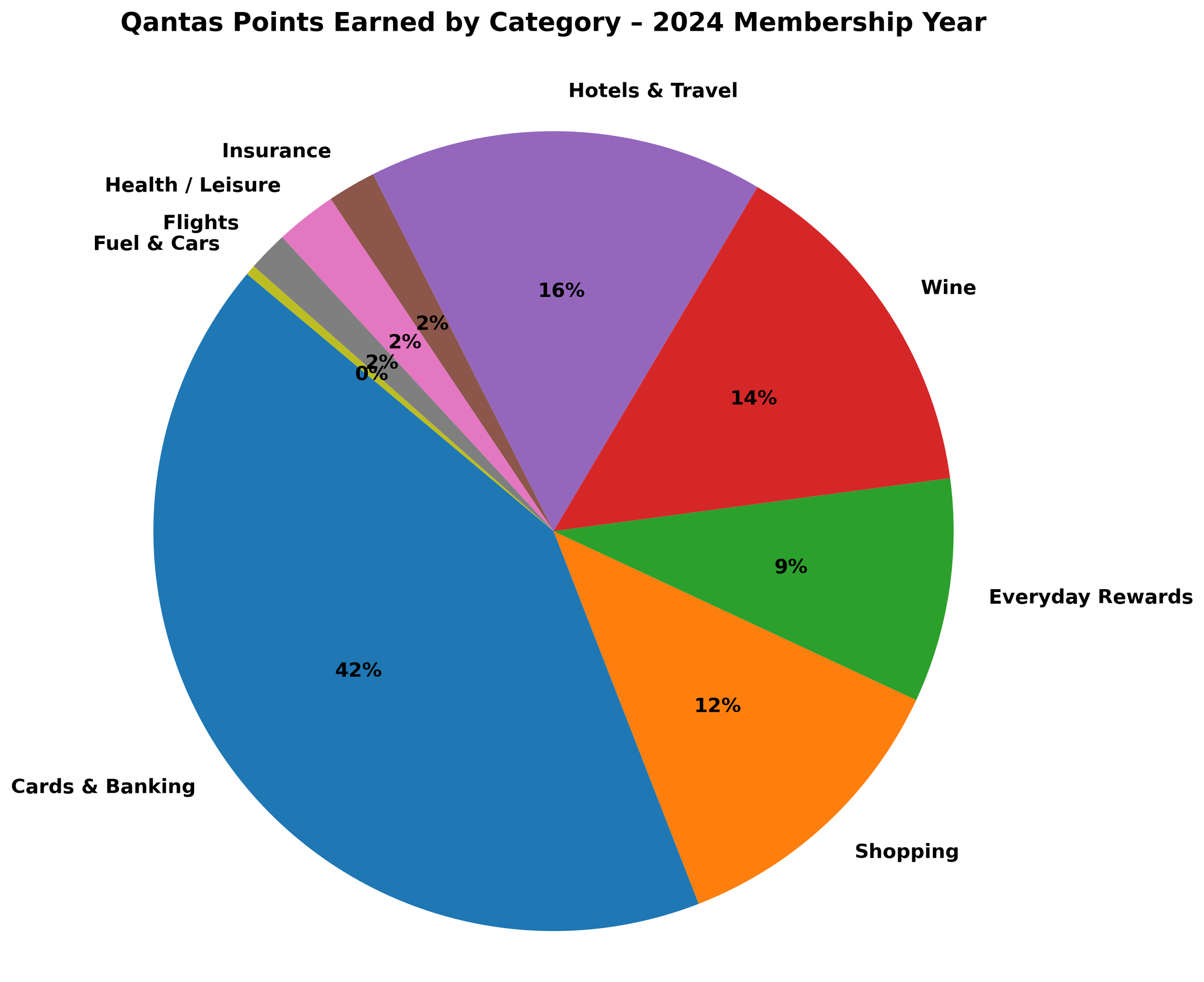
A meaningful share of points came from categories that were not part of my everyday lifestyle, contributing to a more episodic and promo-driven earning profile.
2025 Membership Year
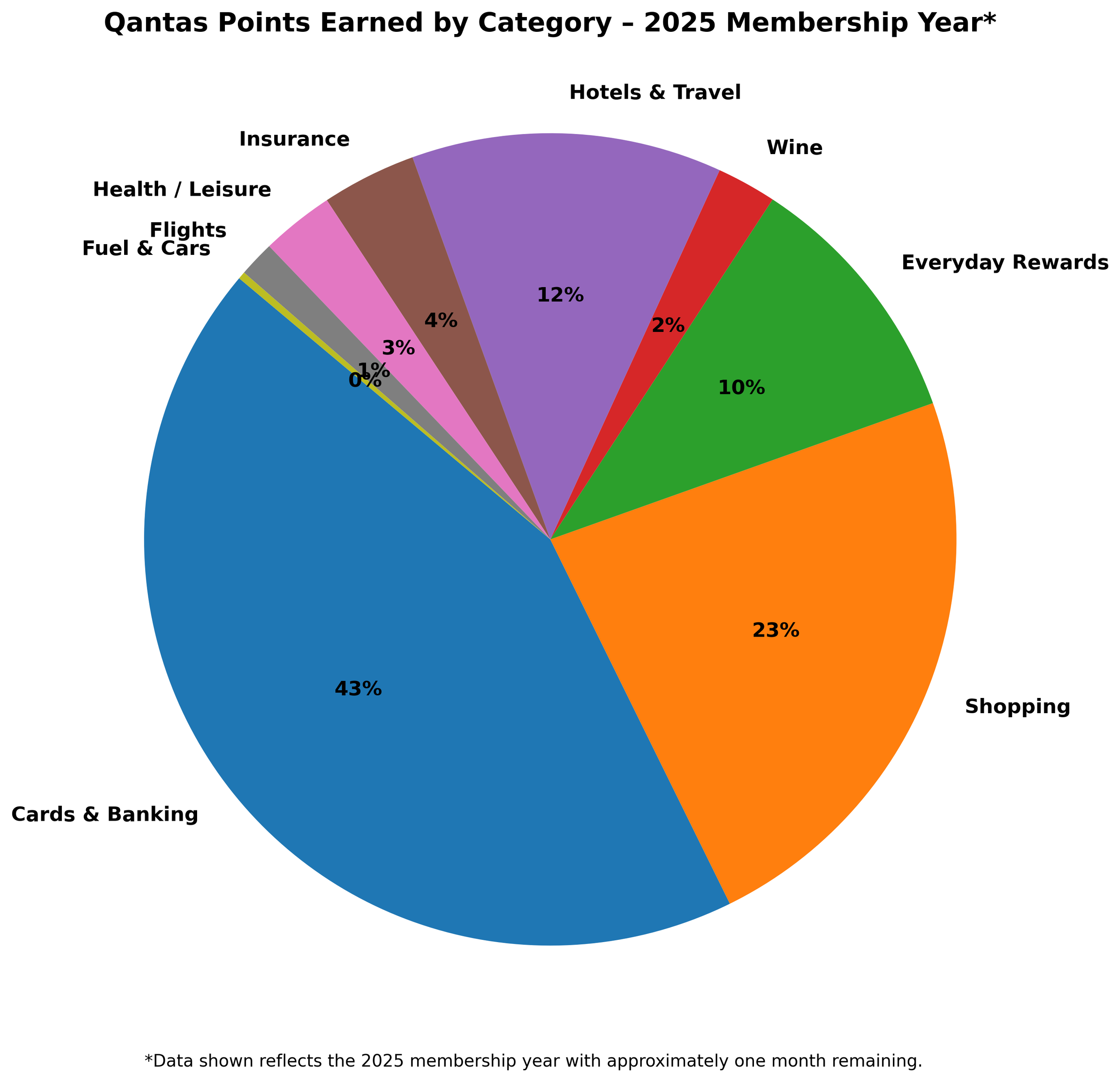
The profile shifted toward genuinely repeatable earning — Everyday Rewards and shopping-led spend — with reduced reliance on non-everyday categories.
Reducing pressure on a single account
Another important shift this year was adding Qantas Business Rewards as a parallel earn stream.
This didn’t inflate my personal Qantas Frequent Flyer results — but it did reduce the pressure to force outcomes into one account.
Separating business-linked earning from personal lifestyle earning made the system calmer and more accurate. Each account now reflects what it’s meant to reflect.
The real outcome: fewer decisions, less noise
The biggest change this membership year wasn’t numerical.
It was psychological.
fewer “should I?” moments;
less urgency around every promotion; and
more confidence letting good offers pass.
The system became quieter — and that’s usually a sign it’s working.
What comes next
At the end of my membership year, I’ll publish a clean, side-by-side comparison — measured the way Qantas actually tracks behaviour.
Not to prove anything.
But to show what happens when points strategies align with real life instead of competing with it.
For now, this review isn’t about totals.
It’s about building a system you don’t have to fight.