
How to Earn More Qantas Points with Gift Cards (Without Spending More)
Most people think earning Qantas Points is about flying more or spending more. It’s not. The biggest gains come from how you structure the spending you’re already doing. In this article, I break down how gift cards fit into a Qantas Points system—why they work, when to use them, and how they can multiply your points without increasing your spend.
Most people think earning Qantas Points is about flying more or chasing credit card bonuses.
In reality, the biggest gains come from something far less obvious:
How you spend the money you were already going to spend.
One of the most effective ways to improve that is through gift cards — not as a trick, but as part of a consistent system.
Why Qantas (and Their Partners) Give You Points
Qantas Points aren’t really a “reward.”
They’re a commercial tool.
Qantas sells points to partners like Woolworths, retailers, and financial institutions. Those partners then use points to influence where you spend.
If you choose one retailer over another because of points:
That business wins your spend
Qantas earns revenue
You get points in return
Everyone benefits—but only if your behaviour changes.
Gift cards take this one step further.
When you buy a gift card:
The retailer locks in your future spend
You’re no longer comparing alternatives
That revenue is effectively guaranteed
That’s why gift cards often come with elevated earn rates.
You’re not being rewarded for spending.
You’re being rewarded for committing.
Why Gift Cards Make Sense in a Points System
Gift cards aren’t the strategy—they’re a multiplier.
They allow you to take the same spending and earn significantly more points from it.
1. You Bring Forward Your Earning
Instead of earning points gradually:
You earn them upfront when you purchase the gift card
Then spend the card later with no additional effort
2. You Stack Multipliers (This Is Where It Gets Powerful)
This is where most people underestimate the value.
Let’s say:
Gift card earns 3–10 points per dollar
Your credit card earns 1–1.25 points per dollar
You’re now earning:
4–11+ points per dollar effectively
Compared to:
~1 point per dollar on normal credit card spend
That’s a completely different outcome over a year.
3. You Improve Spend Efficiency
Gift cards force intentional spending:
You route purchases through high-earning channels
You reduce “leakage” to purchases that earn nothing
This is what turns random earning into a point-creating system.
When Gift Cards Actually Make Sense
This is where most people go wrong.
Use them when:
You were going to spend the money anyway
There’s a meaningful earn rate or promotion
The retailer is part of your normal life
Avoid them when:
You’re buying purely for points
You’re unsure you’ll use it
You’re giving up a better earning opportunity elsewhere
Gift cards should optimise your spending — not create it.
How to Use Gift Cards (Simple System)
Identify predictable spend
→ Groceries, dining, retailLook for elevated earn opportunities
→ Qantas Marketplace, Woolworths promosUse a high-earning credit card
→ Stack the earnSpend as normal
→ No lifestyle change required
Where to Buy: Marketplace vs Woolworths
Qantas Marketplace
Best for consistent, repeatable earning at any time
Minimum 3 points per dollar, ranging to 10+ during promos
Broad retailer range
Woolworths / Big W
Best for targeted, high-value earning during promos
Frequent, predictable promotions
Strong for big retailers, Uber and multifunction gift cards
Simple way to think about it:
Marketplace = everyday consistency (min. 3 points per dollar)
Woolworths = high-impact opportunities (up to 10 points per dollar promotions weekly)
Case Study: Turning Everyday Spend Into a Points Engine
Let’s walk through what this actually looks like over a year.
Assumptions:
Credit card earn: 1.25 pts per dollar
Mix of Qantas Marketplace gift card strategies
No change in actual spending behaviour
1. Groceries (Everyday Spend)
$200/week → ~$10,400/year
Purchased via Everyday Wish gift cards through Marketplace
Earn rate: 3 pts per dollar
Points earned:
Gift card earn → 31,200 pts
Credit card earn → 13,000 pts
Total: → 44,200 points
2. Dining (Restaurants via Gift Cards)
$100/week → ~$5,200/year
Restaurant gift cards at 3 pts per dollar
Points earned:
Gift card earn → 15,600 pts
Credit card earn → 6,500 pts
Total: → 22,100 points
3. General Retail Spend
~$5,000/year across clothing, home, misc
Purchased during typical 3 pts per dollar offers
Points earned:
Gift card earn → 15,000 pts
Credit card earn → 6,250 pts
Total: → 21,250 points
4. One Large Purchase (e.g. TV / Phone / Appliance)
$1,000 purchase
Gift card bought during 10 pts per dollar promo
Points earned:
Gift card earn → 10,000 pts
Credit card earn → 1,250 pts
Total: →11,250 points
Total Annual Outcome
Across normal spending:
Groceries → 44,200 pts
Dining → 22,100 pts
Retail → 21,250 pts
Large purchase → 11,250 pts
Total: → 98,800 Qantas Points
What if you didn’t use gift cards?
Same spend (~$21,600 total):
At 1.25 pts per dollar
Total →27,000 points
The Difference
With gift cards: ~98,800 points
Without: ~27,000 points
→70,000 extra points from the same spend
That’s the equivalent of:
A return domestic Business Class flight
Or a meaningful step towards long-haul premium travel
Without spending an extra dollar.
The Bigger Picture: This Is About Multipliers
If you think about your points system in three levers:
Volume → how much you spend
Coverage → how much of your spend earns points
Multiplier → how many points on each dollar
Gift cards sit squarely under the multiplier lever.
And they’re one of the simplest ways to improve it.
Final Thought
Most people try to earn more Qantas Points by:
Spending more
Flying more
The better approach is:
Earn more from what you’re already doing.
Gift cards aren’t a hack.
They’re a tool.
Used properly, they turn everyday spending into something far more powerful.
Want to Build Your Own Points System?
If this is the first time you’ve thought about points this way, gift cards are just one piece of a much bigger picture.
The real gains come from understanding:
Where your points are coming from
Where you’re missing opportunities
And how to build a system that compounds over time
That’s exactly what I break down inside The Points Pilot Starter Kit—a simple, practical guide to help you start earning more points from what you’re already doing.
If you’re ready to go deeper, the full Points Pilot Guides walk through:
Advanced earning strategies
How to layer multiple earning streams
And how to consistently generate high point balances year after year
Check out similar articles below:



A Year in Review: Why My Qantas Points Strategy Shifted This Membership Year
This isn’t a points total recap. It’s a look at how my Qantas Points strategy shifted this membership year — away from promo-driven spending and toward a calmer, more repeatable system built around everyday spend.
Most “year in review” posts focus on totals.
Big numbers. Screenshots. Highlights.
This one doesn’t.
Qantas measures behaviour by membership year, not calendar year — and with one month still to go, this isn’t about final outcomes. Instead, it’s about something more useful: how my strategy shifted, and why.
The biggest change this membership year wasn’t earning more points.
It was getting clearer on what should count as everyday spend — and building a system that reflects real life, not just promotions.
When points stop reflecting life, the system breaks
One of the easiest traps in points collecting is letting the earning mechanism dictate spending.
That’s when:
You buy things earlier than you need.
You buy more than you otherwise would.
Points stop being a by-product of life and start driving behaviour.
Over time, that creates friction. It also makes the system fragile — because it only works if you keep forcing decisions.
This membership year, I deliberately stepped back from that.
Why I reduced reliance on Qantas Wine
Wine has historically been a strong points earner for me — and it still can be.
But it’s not a significant part of my everyday lifestyle.
That meant any meaningful volume of wine-related points was coming from:
buying ahead of need;
buying more than I’d otherwise consume (and doing a lot of cellaring); and
spending because of points, not because of life.
This year, I reduced that reliance.
Not because wine offers are bad — they’re often excellent — but because earning points should reflect what you already spend, not what you can be encouraged to buy.
Stepping back from wine made the system:
less capital-intensive;
less promo-dependent; and
more honest.
And, importantly, more sustainable.
Dialling up gift cards — deliberately and precisely
At the same time, I deliberately dialled up gift card usage.
Not as a shortcut.
Not to inflate numbers.
But as a precision tool.
Gift cards weren’t about spending more — they were about extracting more value from spend that was already happening.
Used properly, they:
route everyday purchases through higher-earning channels;
allow stacking without changing behaviour; and
turn neutral spend into strategic spend.
This wasn’t blanket buying or speculative stockpiling. It was:
specific retailers;
clear use cases; and
purchased when the numbers made sense.
That distinction matters. Gift cards are powerful because they amplify existing spend — not because they create new spend.
Insurance: timing matters, but it’s not repeatable
Insurance played a role this year, but it’s worth being clear about how.
The points earned here came from timing a policy review to coincide with a promotion. That’s not something you repeat every year, and it’s not something you should force.
Insurance decisions should always be driven by:
coverage;
cost; and
suitability.
Points are secondary.
That said, if you’re already reviewing a policy, aligning timing with a strong Qantas offer can deliver outsized value. It’s not a core system — it’s a lever you pull when the timing is right.
What didn’t change: cards, structure, restraint
One of the quieter shifts this year was actually not changing much.
My card setup remained largely the same. My Qantas Titanium credit card is the workhorse of the points-earning system and changing it for another card wouldn’t make sense at this point.
There was no constant churn.
No weekly adjustments and time-consuming planning.
Once a structure is right, the goal isn’t activity — it’s consistency.
Letting systems run without interference is often the most underrated skill in points earning.
How the earning mix changed
Looking at where points come from — not just how many — tells a much clearer story about strategy.
It highlights whether points are being earned from everyday behaviour, or from discretionary spending driven by promotions.
2024 Membership Year
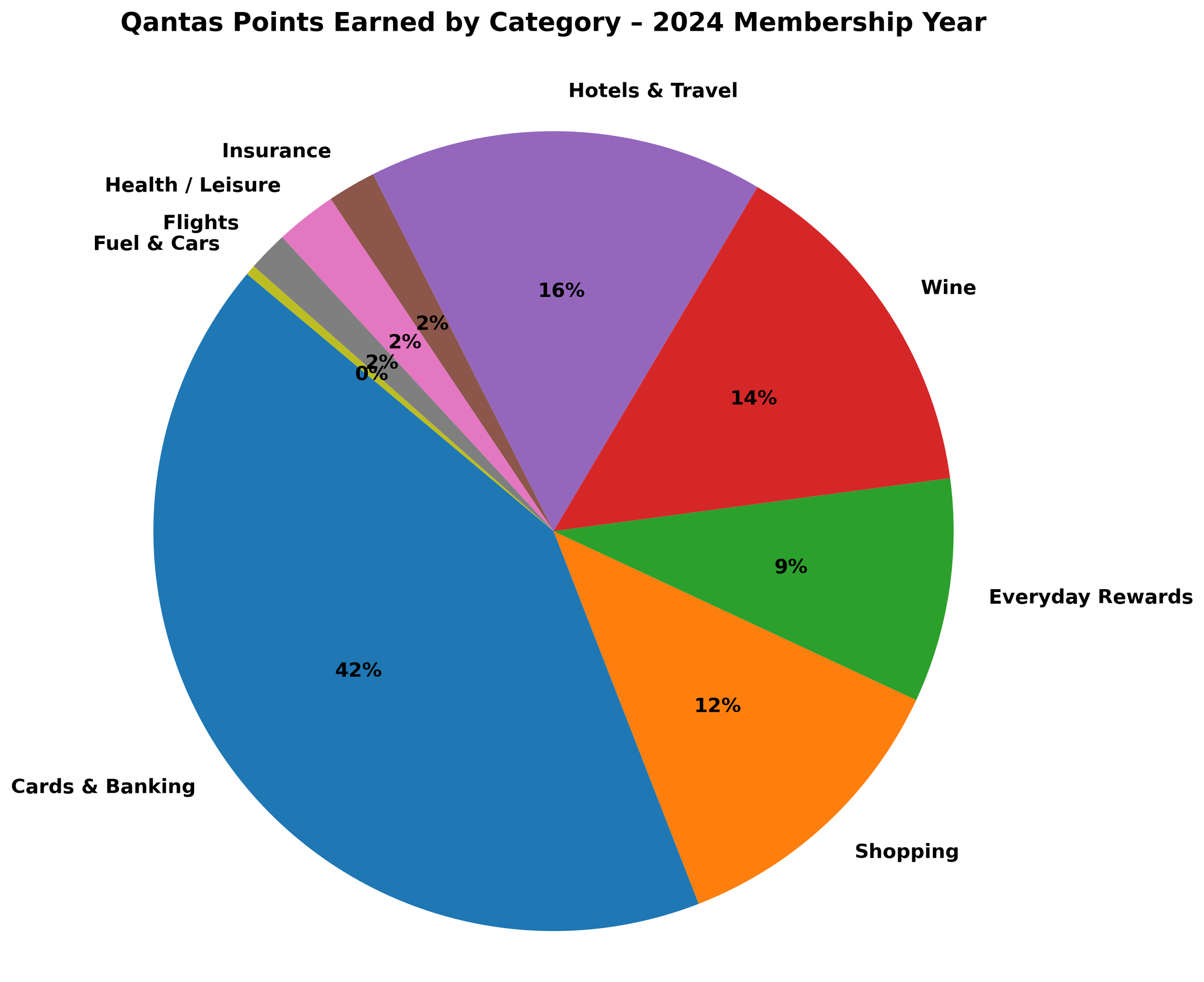
A meaningful share of points came from categories that were not part of my everyday lifestyle, contributing to a more episodic and promo-driven earning profile.
2025 Membership Year
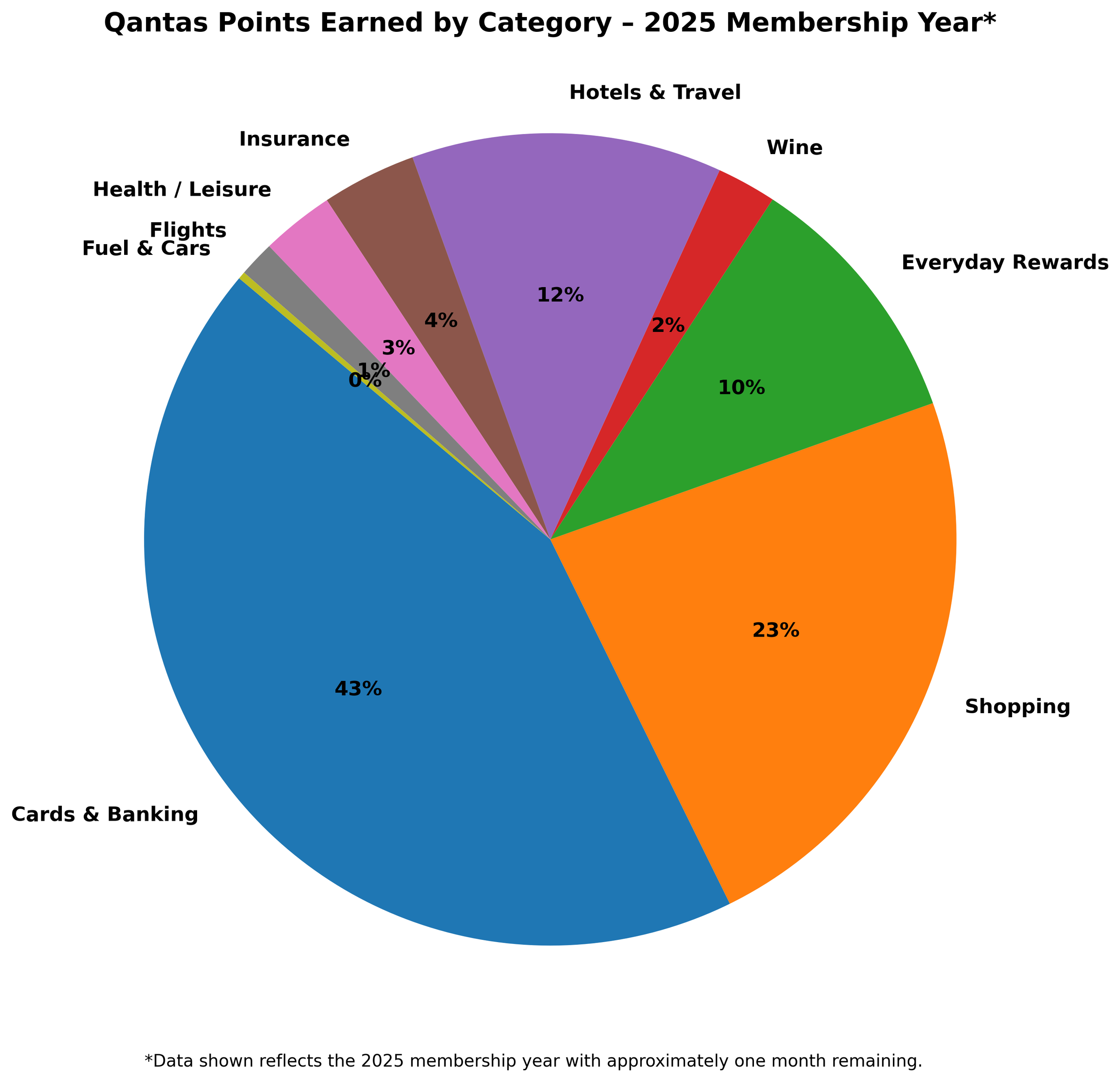
The profile shifted toward genuinely repeatable earning — Everyday Rewards and shopping-led spend — with reduced reliance on non-everyday categories.
Reducing pressure on a single account
Another important shift this year was adding Qantas Business Rewards as a parallel earn stream.
This didn’t inflate my personal Qantas Frequent Flyer results — but it did reduce the pressure to force outcomes into one account.
Separating business-linked earning from personal lifestyle earning made the system calmer and more accurate. Each account now reflects what it’s meant to reflect.
The real outcome: fewer decisions, less noise
The biggest change this membership year wasn’t numerical.
It was psychological.
fewer “should I?” moments;
less urgency around every promotion; and
more confidence letting good offers pass.
The system became quieter — and that’s usually a sign it’s working.
What comes next
At the end of my membership year, I’ll publish a clean, side-by-side comparison — measured the way Qantas actually tracks behaviour.
Not to prove anything.
But to show what happens when points strategies align with real life instead of competing with it.
For now, this review isn’t about totals.
It’s about building a system you don’t have to fight.