


Amex vs Qantas Points: Should You Keep Flexibility or Go All-In?
Once upon a time, you could earn Amex points and transfer to Qantas. Now you have to choose. Here’s how to decide between flexibility and maximising your Qantas points balance.
Once upon a time, this decision was easy.
You could earn American Express Membership Rewards points and transfer them to Qantas, or to other airline programs, depending on what suited you at the time. You didn’t have to commit early.
Today, that flexibility is gone.
If you want Qantas Points, you need to choose a Qantas-earning card from the start. If you want flexibility, you need to give Qantas up.
That creates a genuine dilemma for anyone focused on earning Qantas Points and using them within the Oneworld partner network.
Is it worth keeping an Amex Membership Rewards card open to preserve flexibility, or are you better off committing fully to Qantas and maximising your earning within that ecosystem?
A simple way to think about it
At The Points Pilot, there are three things that ultimately determine how effective any points strategy is:
the baseline of your everyday spend (volume)
how much of that spend can be funnelled through a points-earning strategy (coverage)
and how powerful each dollar of that spend is (multiplier)
Every card, and every strategy, sits somewhere across those three pillars.
And once you look at Amex and Qantas through that lens, the trade-offs become clearer.
Where each option fits
Qantas cards are built for simplicity. You earn directly into the program you intend to use, and everything is aligned from day one. There’s no transfer step, and no decision to make later.
Membership Rewards works differently. You earn a flexible currency first, then decide where those points go once you’ve found a redemption that works.
From a multiplier perspective, Amex often looks strong. Earning two Membership Rewards points per dollar is common, which can outperform many Qantas cards on raw earn rate.
But coverage is more limited. Amex is not accepted everywhere, which means you either miss spend or need a secondary card.
Qantas, when paired with a Visa or Mastercard, tends to win on coverage. More importantly, it extends beyond the card itself. The broader ecosystem allows you to earn points in places that go well beyond everyday spend.
And that’s where the conversation starts to shift.
What flexibility looks like in practice
To make this more concrete, it helps to anchor everything to a single route.
Take Sydney to Singapore, one way in Business Class.
A typical redemption looks something like this:
Qantas requires around 82,100 points
Velocity sits at roughly 67,000 points
KrisFlyer comes in at approximately 53,500 miles
If you are earning directly into Qantas, that’s the number you work towards.
If you are using Membership Rewards, those same redemptions need to be adjusted for transfer rates. Velocity typically converts at 2:1, while KrisFlyer now sits at 3:1.
That means the effective cost becomes:
Velocity: about 134,000 Membership Rewards points
KrisFlyer: about 160,500 Membership Rewards points
Qantas: 82,100 points, with no conversion required
Looked at this way, Qantas appears more efficient.
But that comparison only reflects the end point.
If you are earning directly into Qantas, your outcome depends entirely on Qantas reward availability. When seats are available, the system works well. When they’re not, your options narrow quickly.
With Membership Rewards, you retain flexibility. You can assess multiple programs and only transfer once you’ve found a flight that works.
From a multiplier perspective, that flexibility can improve the value of your points. From a coverage perspective, it gives you more ways to solve the same problem.
Why the numbers don’t tell the full story
There is another layer to this comparison.
Points are not earned at the same rate.
Many Amex cards earn around two Membership Rewards points per dollar, while most Qantas cards sit closer to one Qantas Point per dollar.
So while a redemption might require 134,000 Membership Rewards points, that doesn’t necessarily mean it requires more spend to achieve.
At a rough level, that could represent something like $67,000 of spend on an Amex card, compared to over $80,000 on a Qantas card for a similar outcome.
Higher earn rates can close the gap between programs, and in some cases, make flexible points more competitive than they first appear.
But this is only one part of the picture.
Where Qantas direct earn starts to pull ahead
For most people, the limiting factor isn’t redemption pricing or transfer ratios.
It’s volume.
How many points can you realistically generate over time? For most people, the idea of having to spend $65,000+ to get a single Business Class reward seat seems absurd and this is where the noise about points being pointless seems valid.
But this is where Qantas has a structural advantage over Amex Rewards in Australia.
Not because the direct-earning credit cards are dramatically better, but because of the ecosystem that sits around them.
Qantas allows you to earn points through:
Woolworths Everyday Rewards
Qantas Shopping bonuses
Gift card promotions
Insurance sign-up offers
Qantas Wine
and a wide range of partner deals
These opportunities often deliver far more points than standard card spend alone. In many cases, they are the primary driver of a meaningful points balance.
This is where all three pillars come together.
Qantas doesn’t just offer a card. It offers:
more ways to earn (coverage)
more opportunities to accelerate (multiplier)
even when total spending is capped (volume)
If you split your strategy between Membership Rewards and Qantas, you reduce your ability to fully leverage that system. If you commit to Qantas, those earning streams begin to compound.
So what should you do?
If your priority is flexibility, Membership Rewards still has a place. It allows you to adapt, to compare programs, and to respond to availability as it appears.
But if your goal is to build a large Qantas Points balance and use it consistently, the decision becomes less about flexibility and more about scale.
The question shifts from which program offers the best redemption…
to which system allows you to generate the most points.
Final thought
If you value flexibility above all else, there is still a place for Membership Rewards. It gives you options, and those options can matter when availability is tight or when another program offers a better outcome for a specific trip.
But for most Qantas-focused collectors, that isn’t the constraint.
The real constraint is how many points you can generate over time.
And when you look at it through that lens, the decision becomes clearer.
Qantas isn’t just a card strategy. It’s an ecosystem. The card is only one part of it, and often not the most powerful one. The real acceleration comes from everything around it — partners, promotions, and the ability to stack multiple earning opportunities together.
That’s what drives meaningful balances.
So the question isn’t whether Membership Rewards gives you more flexibility.
It’s whether that flexibility outweighs the ability to generate significantly more points by committing to one system.
For most people, it doesn’t.
Want to go further?
If this has helped clarify your thinking, the next step is putting a structure around it.
The Points Pilot guides break down exactly how to move from earning a few thousand points here and there to building a consistent, scalable points strategy — whether that’s your first 50,000 points or pushing towards 250,000+ per year.
If you’re looking for something more tailored, you can also book a consultation and map out the right setup based on your spending, goals and travel plans.
Because the difference isn’t just in which card you choose.
It’s in how you use the system around it.
Check out some related articles:



Stop Defaulting to Dubai: Alternative Routes to Europe Using Qantas Points
Dubai isn’t the only gateway to Europe. Discover the alternative hubs experienced Qantas points collectors use to unlock reward seats when everyone else is searching the same routes.
For years, there’s been a default strategy for Australians redeeming Qantas Points to Europe.
Fly via the Middle East.
Dubai with Emirates, potentially accessing their famous Business and First Class.
Doha with Qatar Airways (prior to 2023), with their famous Qsuites as a fan favourite.
These routes dominated the conversation because they were convenient, widely marketed, and heavily integrated into the Qantas Frequent Flyer ecosystem.
But relying on a single region — or a single airline partnership — isn’t always the smartest way to play the points game.
Increasingly, experienced points collectors are building more flexible strategies: using alternate hubs, mixing carriers, and constructing multi-city itineraries that open up availability while sometimes reducing taxes or even total points required.
In other words: they’re not tied to one airline.
And when it comes to reaching Europe with Qantas Points, that approach unlocks far more options than most travellers may realise.
Why the Middle East Became the Default
The dominance of Middle East routings isn’t an accident.
Over the past decade, airlines like Emirates and Qatar Airways built massive hub networks designed to connect Australia with Europe in a single stop.
From a Qantas Frequent Flyer perspective, this created a simple redemption pathway:
Australia → Middle East → Europe.
The benefits are obvious:
huge flight capacity
simple one-stop connections
excellent premium cabins
strong airline partnerships
But the simplicity of this routing has also created a kind of tunnel vision in the points community.
When everyone is looking for the same seats on the same routes, award availability becomes scarce — and travellers overlook alternative ways to structure their trip.
The Strategic Shift Smart Points Collectors Are Making
Experienced Qantas Points users tend to approach redemptions differently.
Rather than asking:
“How do I get to Europe on Emirates?”
They ask:
“What combination of airlines and hubs gets me to Europe with the best availability and value?”
That shift in mindset opens up several advantages:
More availability
When thousands of travellers are competing for the same flights through the Middle East, alternative routings often have far better reward seat access.
Lower taxes and carrier charges
Different airlines have very different surcharge structures. Changing carriers — or even just changing your transit hub — can sometimes significantly reduce the cash component of a reward booking.
For travellers willing to think a little more strategically, being flexible can unlock routes that most people never consider.
Alternative Routings to Europe Using Qantas Points
Here are several lesser-discussed ways to reach Europe while staying entirely within the Qantas Frequent Flyer redemption system.
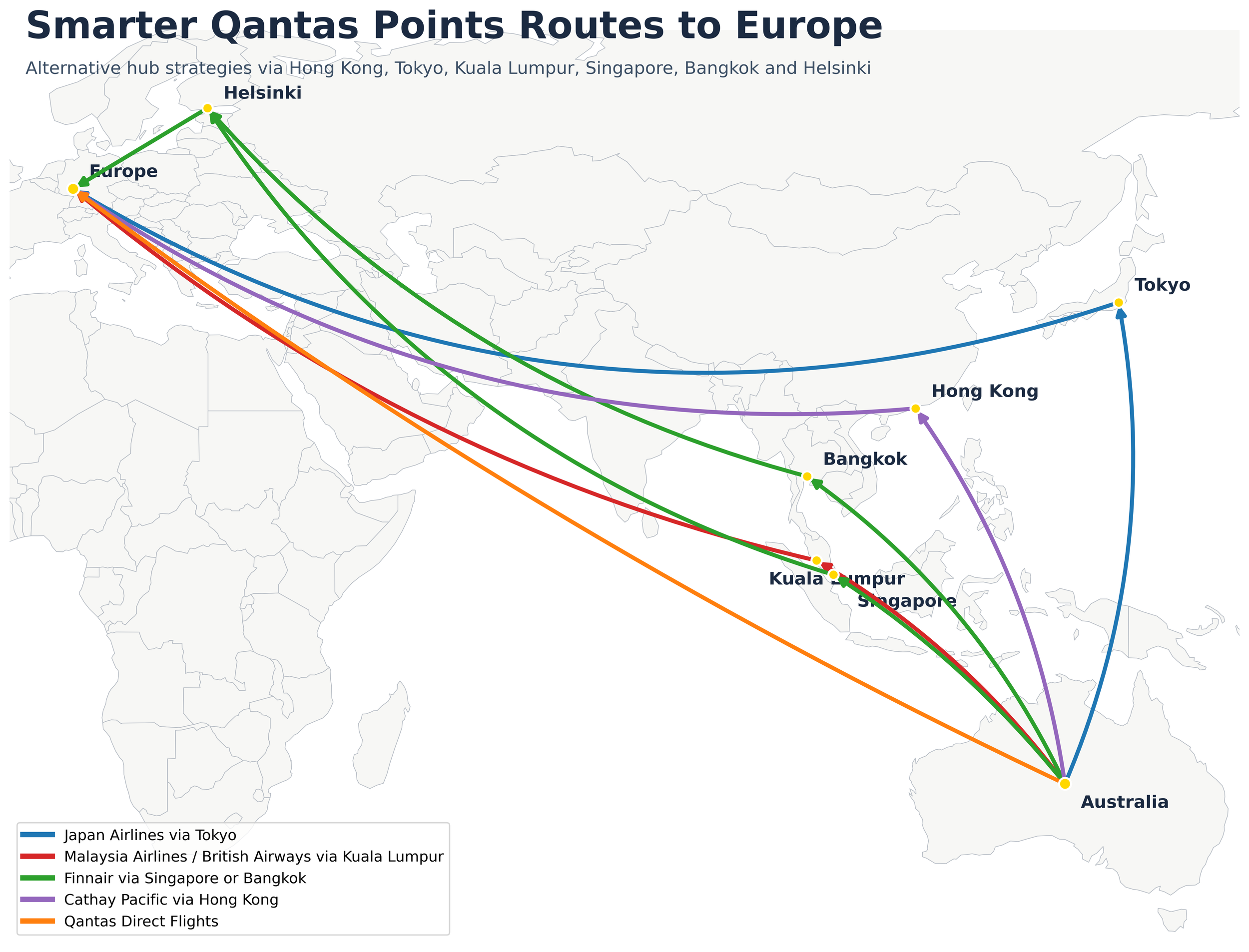
Alternative routes via Hong Kong, Tokyo, Kuala Lumpur and Helsinki that many Qantas members overlook.
Cathay Pacific via Hong Kong
One of the most popular alternatives is Cathay Pacific.
Hong Kong has long been one of the major aviation hubs connecting Asia and Europe, and Cathay maintains a strong network into cities including:
London
Paris
Frankfurt
Milan
Amsterdam
For Australians, the routing looks like:
Australia → Hong Kong → Europe.
While Cathay availability fluctuates, it can sometimes be easier to secure premium cabin reward seats here than on Middle Eastern routes.
Finnair via Asia
Another interesting option involves Finnair, one of Qantas’ Oneworld partners.
Finnair operates a large European network from Helsinki and uses northern polar routings that connect Asia with Europe efficiently.
A possible itinerary could look like:
Perth → Singapore → Helsinki → Europe
or
Melbourne →Bangkok → Helsinki → Europe.
Once in Helsinki, travellers can connect easily to destinations across Europe.
This routing is often overlooked by points collectors focused on Middle Eastern hubs — but it can offer excellent availability and smooth connections.
One of the biggest advantages of Finnair is that their taxes and carrier charges are amongst the lowest in the Qantas ecosystem, allowing travellers to get to Europe for hundreds, rather than thousands of dollars on top of their points.
Japan Airlines via Tokyo
Tokyo is another convenient gateway into Europe.
Japan Airlines offers routes from Tokyo to several European cities including:
London
Paris
Frankfurt
Helsinki
An itinerary could look like:
Australia → Tokyo → Europe.
Japan Airlines offers some of the best Business and First Class experiences available through the Qantas program, and reward seats occasionally appear with far less competition than Middle East routes. Getting to Tokyo can also be achieved through either Qantas or Japan Airlines itself.
Malaysia Airlines/British Airways via Kuala Lumpur
One of the most underrated ways to reach Europe using Qantas Points is via Kuala Lumpur.
For Australian travellers, the routing is simple:
Australia → Kuala Lumpur → Europe.
From Kuala Lumpur you can connect directly to destinations such as:
London
Paris
These connections can be operated by Malaysia Airlines or British Airways, depending on the destination.
This routing is often overlooked by points collectors who default to Middle Eastern hubs, but it has a few advantages:
Major Australian cities have direct flights into Kuala Lumpur, making it a straightforward transit hub.
Because the route receives less attention than Dubai or Doha, availability can occasionally be easier to secure.
Even if Malaysia Airlines seats aren’t available on every segment, you can sometimes combine them with other Oneworld carriers for the European leg.
For travellers willing to think beyond the most obvious hubs, Kuala Lumpur can be one of the simplest and most efficient ways to reach Europe using Qantas Points.
Qantas Direct Flights from Australia
Finally, there’s the most obvious option — flying Qantas directly.
Routes from Australia to Europe now include:
Perth → London
Perth → Rome
Australia → Singapore → London
Some of these flights eliminate the need for any transit hub entirely.
The challenge is availability: reward seats on these routes can be extremely competitive, especially in premium cabins that make the ultra-long haul flights more enjoyable.
But for travellers who monitor releases and book quickly when availability appears, they remain one of the most straightforward ways to reach Europe using Qantas Points.
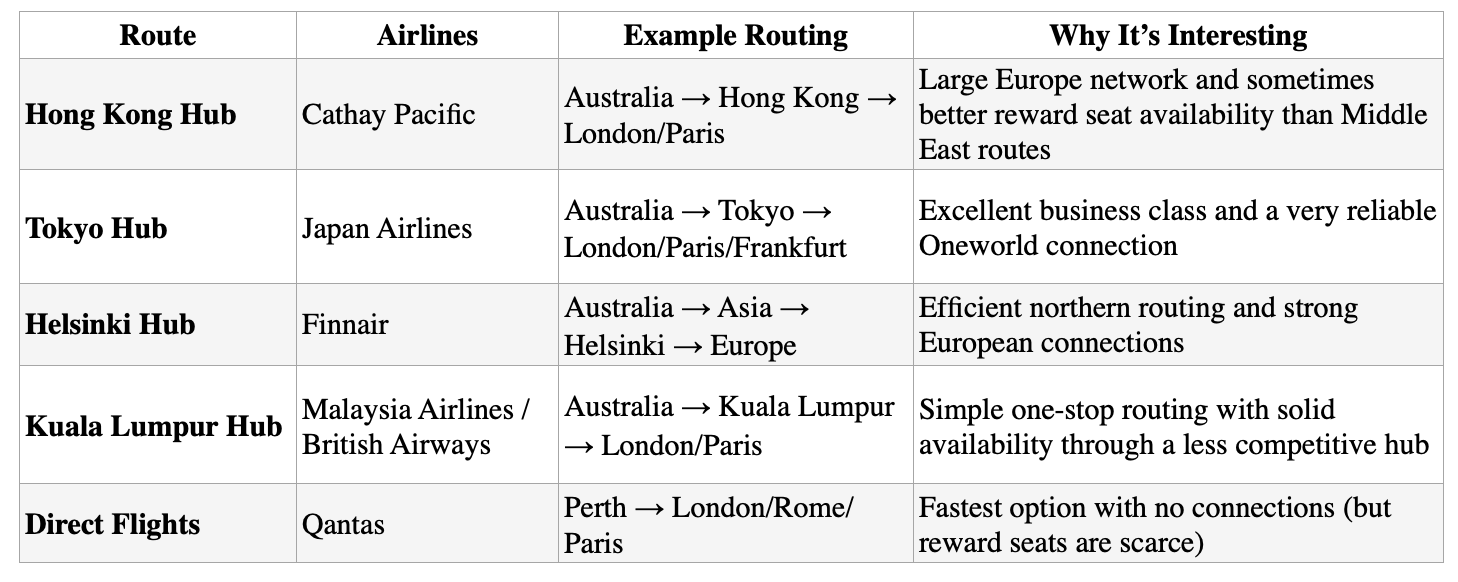
Comparison of different routing
The Points Pilot Strategy: Build Flexibility Into Your System
One of the biggest mistakes points collectors make is building their entire strategy around a single airline.
Airline partnerships evolve.
Award availability changes.
Routes appear and disappear.
Smart points collectors build a system that gives them multiple pathways to the same destination.
Instead of focusing only on:
Australia → Dubai → Europe
They keep several alternatives in mind:
Australia → Hong Kong → Europe
Australia → Tokyo → Europe
Australia → Asia →Helsinki → Intra-Europe
Direct Qantas flights.
This approach dramatically increases your chances of finding reward seats when you actually want to travel.
It also opens the door to more creative itineraries — including multi-city trips that combine different airlines and hubs along the way.
The Bottom Line
Flying through the Middle East has long been the default path from Australia to Europe using Qantas Points.
But it’s far from the only one.
For travellers willing to think strategically, alternative hubs like Hong Kong, Tokyo, and Helsinki can unlock routes that many Qantas members never even consider.
And that’s the real lesson for serious points collectors:
The smartest strategies aren’t built around one airline — they’re built around flexibility.
Want to Go Deeper?
If you want to go beyond the basics, The Points Pilot guides break down the exact systems experienced collectors use to consistently earn and redeem large volumes of Qantas Points.
Inside the guides you’ll learn:
• how to structure your earning strategy around major promotions
• how to stack multiple point-earning opportunities throughout the year
• how experienced collectors reach 100k, 250k or even 500k+ points annually
Whether you’re just starting out or looking to optimise your strategy, the goal is simple:
Helping you cut through the noise and make Qantas Points work for you.
Explore the guides, or book a strategy session, at The Points Pilot.
Check out some related articles below