How I Earned Nearly 750,000 Qantas Points in One Year (Without Credit Card Bonuses)
This isn’t a flex.
It’s not a leaderboard, and it’s not meant to suggest that this is the “right” way to earn points.
This is simply a follow-up to something I said I’d do — to show what happens when a points-earning system is built around real life, rather than competing with it.
Below is a clean breakdown of how many Qantas Points were earned across the last membership year, where they actually came from, and what changed compared to the year before. No bonuses, no referrals, no manufactured behaviour — just a system allowed to run for a full year.
The headline numbers
Total Qantas Points earned (2025 membership year): 746,056
Comparable earn last year (2024 membership year): 640,411
Year-on-year increase: +105,645 points (+16.5%)
That increase happened despite:
travelling less
deliberately reducing Qantas Wine spend
overall spending remaining similar
The point of publishing this isn’t the number itself. It’s what the breakdown shows underneath.
Points earned by category (2025 membership year)
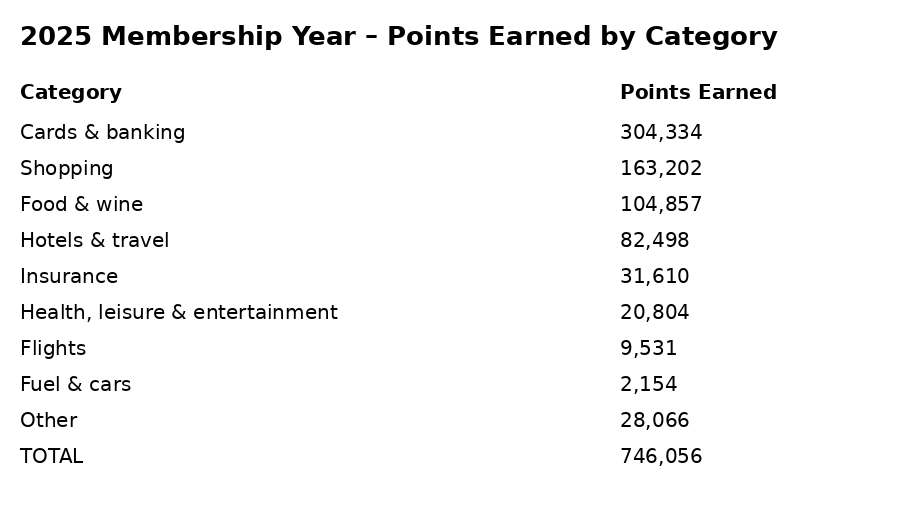
(Table: raw points by category)
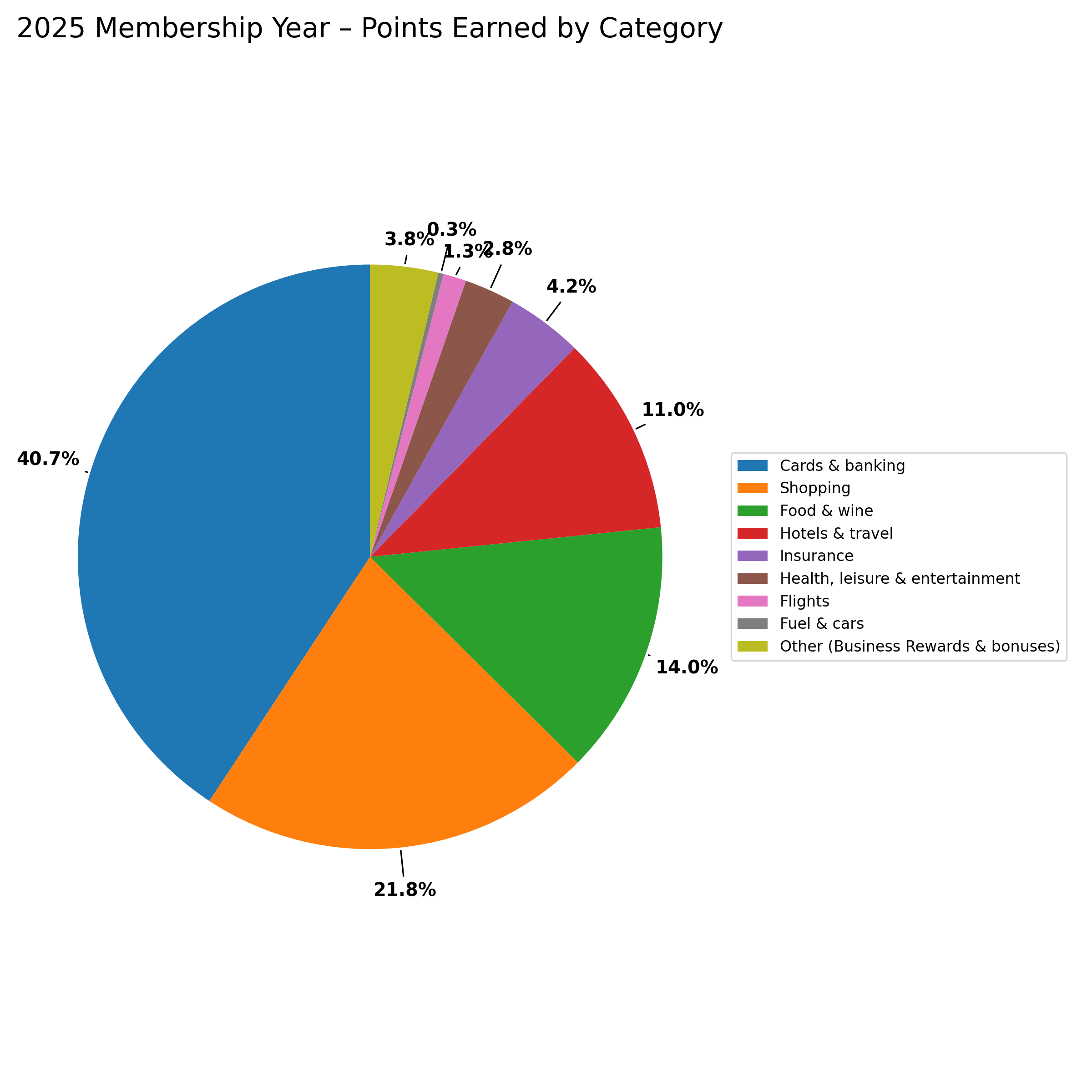
(Pie chart: percentage share of total earn)
The visual makes one thing immediately clear: this wasn’t driven by novelty or spikes. Cards and everyday spending did the heavy lifting. Everything else played a supporting role.
Year-on-year comparison
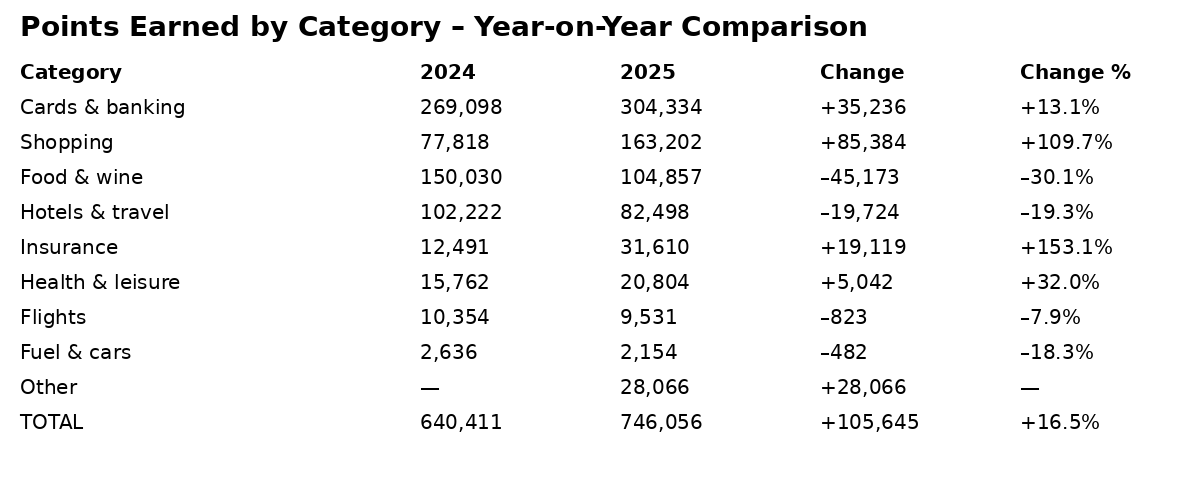
(Table: side-by-side comparison)
Note on “Other”:
This category primarily reflects Qantas Business Rewards activity, which did not feature in the prior year, alongside a small number of minor loyalty bonuses and promotions. It’s included for transparency, but not relied upon as a core driver of the comparison.
What actually drove the change
Cards & banking: same spend, better structure
Cards and banking remained the single largest source of points this year, accounting for just over 40% of total earn.
What’s notable isn’t that this category grew — it’s how it grew.
There wasn’t a meaningful increase in overall spend across the year. Instead, the improvement came from spending more effectively, by leaning into the structure of the card rather than chasing additional volume.
The primary driver here was my Qantas Premier Titanium card, and specifically a more deliberate focus on maximising its points-per-dollar return. Rather than treating card spend as a flat earn rate, more purchases were routed through channels that offered built-in multipliers — most commonly by purchasing gift cards through the Qantas Marketplace.
The effect is simple but powerful: the same dollar of spend does more work.
There were no sign-up bonuses, no referral incentives, and no one-off spikes inflating the result. The uplift came purely from understanding how the card is designed to reward behaviour, and then aligning those features to my everyday spending.
In other words, this wasn’t about spending more — it was about letting the card do what it’s already built to do.
Shopping: the biggest shift
Shopping was the category with the largest year-on-year increase, more than doubling compared to the previous membership year.
This wasn’t driven by spending more for the sake of it. It was driven by a shift in how everyday purchases were made.
The biggest change was a much more deliberate use of gift cards — particularly through the Qantas Marketplace, and secondarily via Woolworths, where Everyday Rewards could be converted across to Qantas Points. In the prior year, gift cards played a negligible role. This year, they became a recurring part of the system.
The logic is straightforward: gift cards allow you to lock in points before the money is spent, often at higher effective earn rates than paying a merchant directly. Once you start seeing that leverage, it’s hard to unsee it.
Importantly, this wasn’t about perfection. There’s still meaningful headroom in this category, and plenty of occasions where purchases could have been routed more efficiently. But the difference between not using gift cards at all and using them deliberately some of the time is enough to explain the size of the uplift on its own.
In other words, shopping didn’t grow because it was pushed harder — it grew because it was structured smarter.
Food & wine: a deliberate reduction
Food and wine is the category that declined most noticeably year-on-year, and that reduction was intentional.
In previous years, wine played a larger role in the points strategy — often because bonus points made it attractive to buy ahead of actual consumption. Over time, that approach did what it was supposed to do, but it also created a surplus.
This year, that surplus mattered.
With my partner and I drinking less, there simply wasn’t a need to continue buying wine for the sake of earning points. Rather than forcing spend to keep a category looking healthy, the decision was made to let consumption — not incentives — dictate behaviour.
The same applied more broadly to food. There was a conscious move away from delivery platforms like Uber Eats and towards cooking at home more often. That reduced overall spend in the category, and the points followed.
The important thing here isn’t that food and wine earned fewer points. It’s that the system allowed this category to shrink without breaking anything else.
Points strategies only work long-term if they flex with real life. This year, food and wine did exactly that.
Hotels & travel: fewer trips, smaller drop than expected
Hotels and travel earned fewer points this year, largely because there were fewer trips overall — particularly overseas and interstate travel, where earning rates tend to be higher.
That reduction was expected. It reflects a quieter travel year rather than a change in strategy.
What’s more interesting is what didn’t happen.
Despite travelling significantly less, the decline in points from this category was relatively modest. That was partly due to being more deliberate about how accommodation was booked, including leaning into Qantas Hotels promotions when they made sense, rather than treating travel earning as automatic or incidental.
More importantly, this category highlights something central to the system as a whole: not every year is a heavy travel year.
Some years you fly more. Some years you don’t. A points strategy that only works when you’re constantly on the move is fragile. This year was a reminder that when everyday earning is doing the heavy lifting, travel becomes a bonus — not a dependency.
Even with less travel, total points earned across the year increased. That’s a useful stress test for the system.
Insurance: a useful boost
Insurance saw a noticeable increase this year, driven by the timing of policy renewals and the availability of Qantas promotions.
In this case, a policy was up for renewal, and rather than treating that as a passive expense, the timing was used to take advantage of an introductory points offer. That alone explains most of the uplift in this category.
This isn’t something that will happen every year — and it’s not designed to. Insurance remains a relatively small slice of the overall earning picture, and that’s intentional.
Viewed in context, insurance points function exactly as they should within a balanced system: a useful boost when the opportunity arises, not something the strategy depends on year after year.
When they show up, they’re welcome. When they don’t, nothing breaks.
Health, leisure & entertainment: lifestyle reflected
Health, leisure and entertainment saw a modest increase this year, driven less by strategy and more by lifestyle.
As a Qantas Health Insurance policyholder, points are earned through the Qantas Wellbeing app, which rewards everyday activity like steps and movement. Over the past 12 months, I’ve been running more and generally more physically active, and that simply flowed through into this category.
There was no optimisation here, no deliberate attempt to “earn more.” The increase reflects a year where activity levels were higher — and the points followed.
That’s exactly how this category should behave. When lifestyle changes, the earning adjusts with it. When it doesn’t, nothing needs to be forced.
Flights, fuel, and cars: intentionally minor
Flights contributed very little to points earned this year, simply because very few flights were actually paid for.
Across the entire membership year, there were only a handful of paid flights — three in total — all booked as discounted economy fares. Everything else was either redeemed or not flown at all. The low earn here isn’t surprising, and it’s intentional.
If anything, this serves as a useful proof of concept. Despite minimal paid flying across the year, total points earned still increased significantly. That’s exactly the outcome you want if the goal is to build a system that doesn’t depend on being constantly in the air.
Fuel and cars followed a similar pattern. I don’t drive particularly often, which means I don’t refuel frequently, and the points reflect that. For someone who drives daily, this category can matter. For me, it’s naturally small — and that’s fine.
Neither category needs to be forced. They contribute when they make sense, and stay quiet when they don’t.
Other: Business Rewards enters the picture
The “Other” category appears for the first time this year and deserves a brief explanation.
The majority of points in this bucket came from Qantas Business Rewards, which I’ve begun leaning into since starting The Points Pilot. This represents a new earning stream rather than an increase in spending.
In practical terms, it’s been a matter of routing certain expenses through the business where appropriate, allowing points to be earned in parallel with personal activity. Even at a relatively small scale, the ability to earn on previously untapped expenses is meaningful.
This isn’t yet a core driver of the system — and it doesn’t need to be. But it’s a useful reminder that once you’re operating a business, even a small one, additional earning pathways open up that simply don’t exist on the personal side.
It’s early days for this category, but it’s one I expect to become more relevant over time.
What the points were actually used for
Earning points is only half the equation.
The reason I care about building a system like this isn’t the balance — it’s what the balance enables. Redemptions are where all of this turns into something tangible: flights you wouldn’t otherwise book, trips you’d delay or downgrade, and experiences that would feel out of reach if paid for in cash.
I could publish a separate breakdown of redemptions, but what’s more important is the number - 703,648 points redeemed.
Earning only matters because redeeming changes what travel looks like.
Last year I was fortunate to be able to book multiple flights that I would have otherwise had to pay for - many in business class that I would find it hard to justify spending my hard-earning money on otherwise. Points made those trips possible and it’s why I am so passionate about finding ways to turn money I’m already spending on everyday purchases into trips I wouldn’t otherwise be able to take.
A final thought
This system isn’t finished. It’s still evolving.
There are categories I under-utilised this year. There are others I’ll lean into more in the next. And some years will look completely different depending on how life unfolds.
That’s the point.
You don’t need to copy someone else’s numbers. You need a structure that fits your life — one that adapts when your habits change and still compounds quietly in the background.
When you get that right, the points stop feeling like a game — and start feeling like leverage.
If this breakdown does anything, I hope it encourages you to build (or refine) a system of your own. Done properly, the results can be genuinely life-changing — not because of a single trick, but because the structure is doing the work for you. If you need help with that, take a look at the guides on the site or reach out about a bespoke points-system consultation.
Check out these other articles below: